

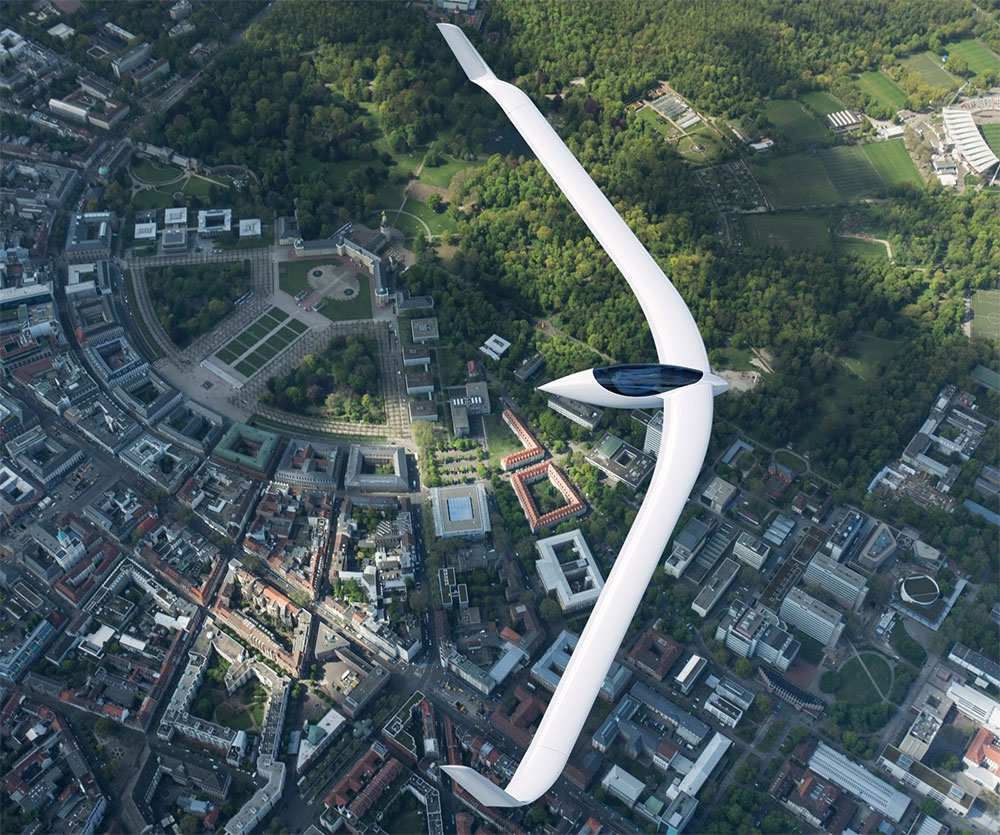
The AK-X: A Flying Wing Glider Still Taking Shape
For over a decade, a group of engineering students at the Karlsruhe Institute of Technology in Germany has been working on one of the most unconventional sailplane projects in the world. The AK-X, developed by Akaflieg Karlsruhe, is a tailless flying wing designed to compete within the FAI 15-metre class, and it represents a genuinely different approach to how a high-performance glider can be made to fly.
The project began in October 2010, and the work being done is not a modification of an existing concept. Rather, Akaflieg Karlsruhe has set out to solve a set of problems that have prevented flying wings from competing seriously with conventional sailplanes. Previous designs in this configuration, most notably the Akaflieg Braunschweig SB-13 as the most similar precedent, demonstrated both the promise and the difficulty of the pure flying wing format. Pitch stability, stall behaviour, and control authority have historically been the sticking points, and those are exactly the areas the AK-X addresses from first principles.
Design Philosophy
The aim of the project is a tailless sailplane that offers high flight performance together with good-natured and manageable flight characteristics — a combination that has proven difficult to achieve in previous flying wing designs. A swept-back wing with winglets was chosen as the configuration, which allows the use of high-performance aerofoils that would otherwise be incompatible with a tailless layout.
The wings of the AK-X are swept at 25 degrees, a fairly strong angle chosen specifically to achieve pitch stability comparable to that of a conventional aircraft. This sweep does introduce its own complications: ground clearance on the outer wing becomes problematic at high angles of attack, which is one reason the team chose a mid-wing rather than a low-wing configuration, and also one reason flaps are used. The bending-torsion coupling inherent in a swept wing can also provoke flutter at relatively modest speeds. To maintain an acceptable maximum speed, the wing structure is built to a high degree of rigidity and the span is limited to 15 metres.
The Control System
In order to make elevator control effective without a tail unit, the AK-X uses three-part wing flaps on each side. These simultaneously fulfil the functions of aileron, elevator, and camber-changing flap. For pitch control, the inboard and outboard sections deflect in opposite directions — a configuration that generates more lift and less drag than a conventional elevator arrangement, particularly in slow flight. At low speeds all surfaces deflect downward as they would on any flapped sailplane; at high speeds they deflect upward. The result is pitch authority that is efficient rather than parasitic.
Yaw stability and lateral control are provided by large winglets with integrated rudders. These are deflected differentially to generate turning forces, and their profiling is specifically designed to reduce induced drag at the same time. The overall arrangement follows the precedent set by the SB-13, though the AK-X extends and refines the concept considerably.
Stall Characteristics
One of the more critical design goals for the AK-X is benign stall behaviour — a characteristic notoriously difficult to achieve on a flying wing. The team chose an almost rectangular wing planform and set the wing geometrically so that the flow separates first in the inner wing area. This produces a relatively harmless forward stall and significantly reduces the risk of a fully detached flow spreading across the entire wing simultaneously. The outcome is a stall that the pilot can recognise and recover from, rather than one that arrives without warning and degrades rapidly.
Structural Testing and Scale Model Work
Before construction of the full-scale prototype began, the aerodynamic design was tested and refined using scale models at 1:3.75 and 1:2. These flights allowed the team to investigate handling qualities under normal conditions and to explore more demanding situations, including spin testing. The 1:2 model provided meaningful confidence in the configuration before the commitment to a crewed aircraft.
On the structural side, the standard testing procedures for glider construction have been followed, including fracture tests for wings and winglets. The team has paid particular attention to robustness — including in the undercarriage — so that adequate safety reserves are available during both test flying and routine operation. Wing and winglet fracture testing was carried out at the DLR (German Aerospace Center).
Construction Progress
Construction of the full-scale crewed prototype has been underway since 2016, progressing through the successive stages of wing shell lamination using resin infusion, fuselage moulding, winglet fabrication, and systems installation including the control rod runs within the wing. The work is carried out by students in Akaflieg Karlsruhe's workshop on the KIT west campus, with each member contributing around 300 hours per year to the project.
Progress is documented on the group's German-language blog and through a dedicated YouTube playlist that covers the build in considerable detail. As of early 2026, the AK-X prototype has not yet made its maiden flight and no firm date has been publicly announced.
Preliminary Technical Specifications
|
Competition Class |
FAI 15 m |
|
Wing Surface |
10.2 m² |
|
Winglet Height |
1.4 m |
|
Sweep |
25° |
|
V-Shape |
2° |
|
Maximum Mass |
550 kg |
|
Maximum Speed |
265 km/h |
|
Maneuvering Speed |
195 km/h |
Looking Ahead
For glider pilots and designers watching from the outside, the interest in the AK-X lies less in when it will first leave the ground and more in what it might demonstrate when it does: that a flying wing can be designed, from the outset, to behave like a well-mannered sailplane rather than a compromise between stability and performance. The theoretical foundations of the design are considered sound enough that Akaflieg Karlsruhe has already initiated the AK-11, a follow-on project that builds on the lessons of the AK-X and explores a wing concept with a gapless leading-edge flap intended to raise achievable wing loading further.
That a successor project has begun before the AK-X has flown is characteristic of academic aviation development, where the knowledge generated during design and construction is often as valuable as the aircraft itself. What the AK-X ultimately demonstrates in the air will be watched with considerable interest by anyone who has ever wondered whether the flying wing's long-promised potential for high-performance soaring might finally be within reach.
Source: Akaflieg Karlsruhe — https://akaflieg-karlsruhe.de/en/ak-x