

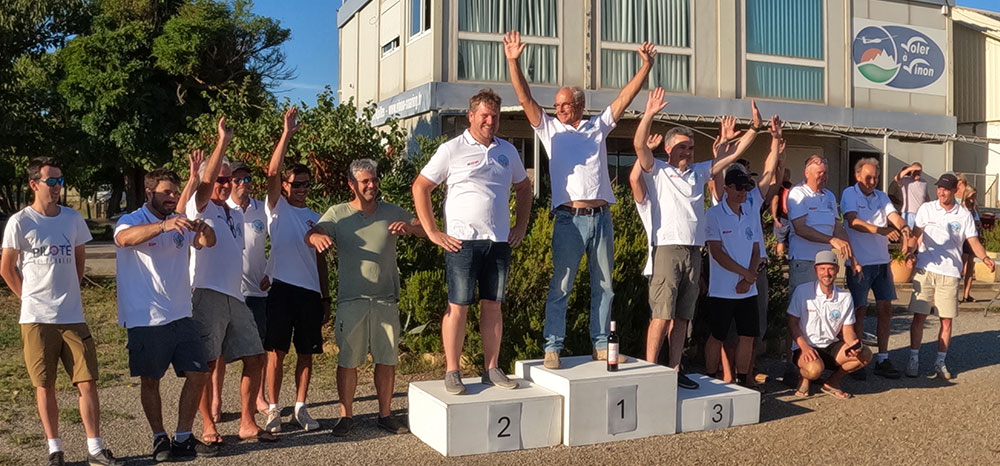
The Winners podium for Race 2 at SGP Vinon
The thirteenth series of the FAI Sailplane Grand Prix has arrived at Vinon-sur-Verdon, where the Association Aéronautique Verdon Alpilles is hosting the French round from 30 August to 5 September. Vinon at the foot of the Southern Alps has long been a proving ground for mountains soaring and. Twenty pilots from across Europe are competing for points toward qualification for the Series 13 final in Chile.
Race 1: Kiessling Sets the Pace
Racing opened on 30 August with strong conditions across the task area. The day began under blue skies before cumulus development spread through the afternoon, with cloud bases reaching 3,500 m over the mountains. The organisers set a 275 kilometre task running north from Manosque Pont, out to turnpoints at Jausiers and La Cluse, back through a report point at Pontoise Farm, and home to the finish at Vinon. The start line opened at 12:50 UTC with a ceiling of 1,600 m.
Mario Kiessling, flying a Ventus 3T, took the win after a well-judged route choice on the run north. Rather than following the direct line down the middle of the Durance valley near Sisteron, he worked the west side via the Chabre ridge, picking up lift that gave him an edge over pilots who had taken the more obvious line. That decision paid off on the run home: Kiessling covered the final leg to Pontoise Farm at a sector speed of 233 kph, more than 22 kph faster than his closest rival, and crossed the finish line with 121 metres of height in hand. His overall speed for the task was 128 kph, completed in just over two hours.
Didier Hauss, flying a JS-1, had led after the first leg at 109 kph and stayed with Kiessling through the middle of the course, but a final glide of 211 kph left him 34 seconds behind at the finish. Erik Borgmann took third in a JS-3, touching the finish line at exactly the minimum height of 315 metres despite spending around forty percent of his flight time thermalling, finishing just 59 seconds off the lead. Kévin Faur and Conrad Hartter completed the top five, both within a minute and a half of the winner.
The result set an early tone for the week: with speeds this close, positioning on the course and the timing of climbs mattered more than raw glider performance.
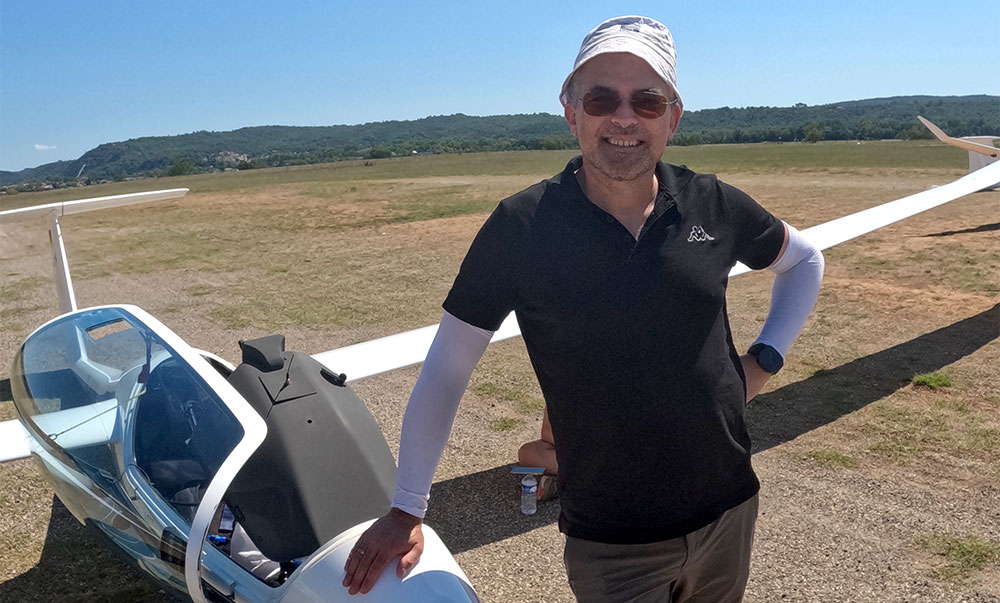
Mario Keissling won Race 1
Race 2: Didier Hauss wins the day
Didier completed the 319.57 km task at 134.4 kph to win the day and put him in the lead with 18 points. Patrick Puskeiller took 2nd place gaining his first 8 points. Mario Keissling came 3rd gaining 7 points ant putting him in 2nd place after two races.
Full results and live tracking at sgp.aero/france-2016
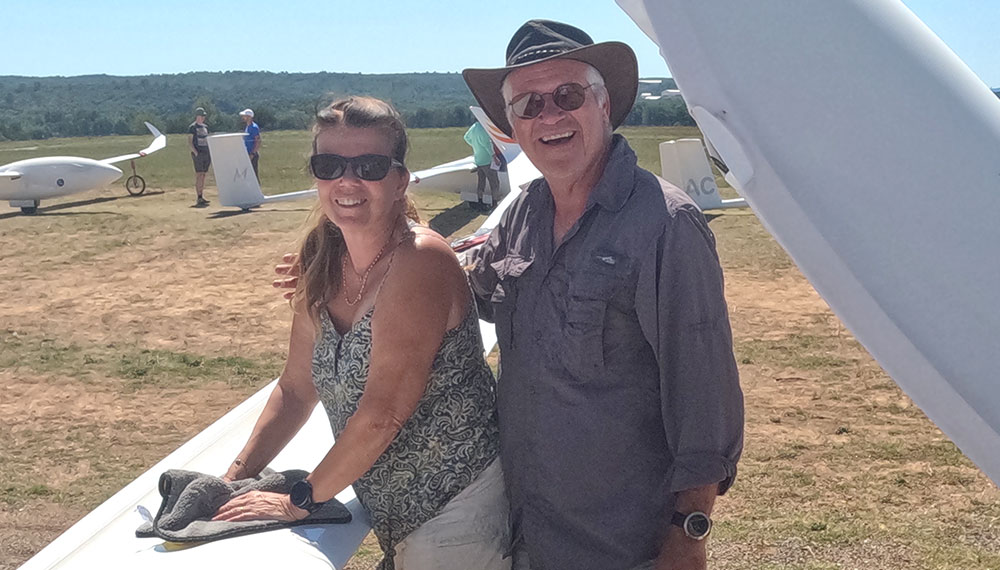
Eric and Joyce Borgmann on the flight line.
- Details
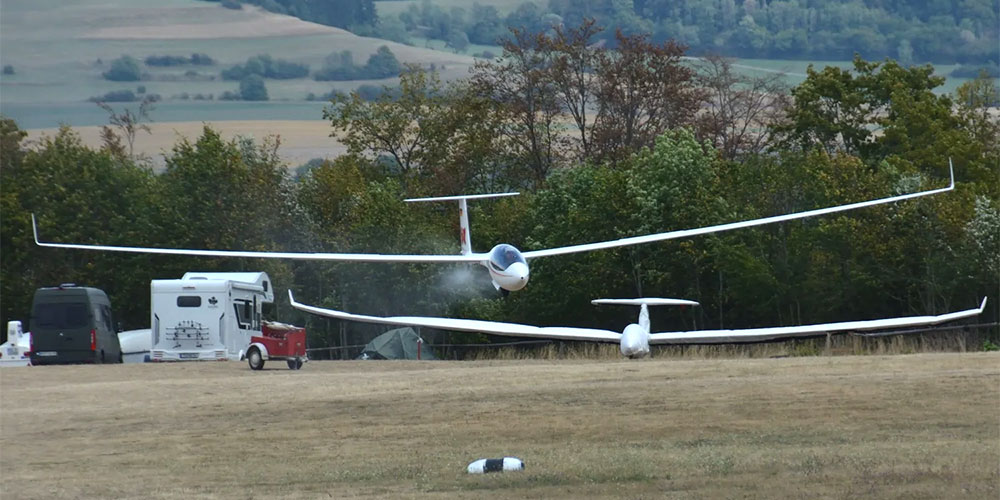
The FAI Sailplane Grand Prix returned to Germany from 9 to 15 August 2026, hosted by FSV Tübingen at Farrenberg, a hilltop airfield between Hahnweide and Klippeneck known among the fleet as the 'aircraft carrier.' Twenty pilots from seven countries lined up, flying a mix of Ventus 3, JS3, JS1, ASG 29, AS 33 and Diana 4 gliders.
Practice Day – 8 August
The training day gave the grid a final look at the terrain before racing began. Conditions were mostly blue thermals, with some high cirrus that burned off during the day. The task committee set a 279 kilometre course from Farrenberg into the Black Forest, with turnpoints at Neustadt-Titisee, Hornisgrinde, St. Georgen and Heufeld before the return to Farrenberg, with a take-off time of 13:00.
Conrad Hartter, flying local knowledge in his JS1c Jet, was first across the start line, but it was Stefan Langer in an AS 33Es 18 metre who took the win by two minutes nine seconds, at an average of 143.8 kph over one hour, fifty-six minutes and ten seconds. The race turned on legs four and five. Langer had been only mid-field through the first three legs, but ran leg four (Hornisgrinde to St. Georgen) at 177.7 kph as the field's speed spread widened to 66 kph, and Hartter answered with 193.1 kph on the same leg, still not enough to close the gap. On leg five, Langer's own pace slowed to 175.9 kph, the slowest of the podium group, but the lead built earlier held. His discipline on the climbs told the story: 36 percent of his flight time spent in just 28 thermals averaging 2.4 metres per second, and a finish height only 31 metres above the minimum, a tight energy budget that worked out.
Peter Millenaar took third in a JS3-Jet 18 metre, just 25 seconds behind Hartter, helped by a 232.3 kph final leg after finding a 4.0 metres per second climb, the best of the day. Michael Reiner was fourth, nine seconds further back, having found the strongest single thermal of the top five at 4.5 metres per second. Dirk Windmüller rounded out the top five, three minutes thirty-two seconds off the lead, flying a consistent race without the late acceleration of the pilots ahead of him.
Race 1 – 9 August
The opening race set a 379 kilometre task and delivered a demanding, shifting day. What started as a fast run under cumulus turned into a tactical battle as heavy rain cells moved into the course on the final leg, forcing pilots to divert around sink and rain and reshuffling the leaderboard.
Stefan Langer, again flying his AS 33 18 metre, took the win in 03:01:54 at an average of 124.7 kph, with finishing speeds across the field clustered between 114 and 125 kph on a day of thermals averaging 2.0 to 2.4 metres per second. Langer's victory was built on two legs in particular. On leg three, from Gerstetten to Ellwangen, he pushed to 149.4 kph while Rasmus Ørskov managed only 123.7 kph on the same stretch. On leg six, the run home from the Heufeld reporting point to Farrenberg, the spread between fastest and slowest pilot reached 133.8 kph; Langer flew it at 238.6 kph, and Ørskov's reply of 223.2 kph left him 44 seconds short at the finish.
Ørskov took second, with Peter Kvistgaard Toft completing the podium in his ASG 29E 18 metre, one minute forty-five seconds behind Langer at an average of 123.5 kph. Toft logged the best climb of the top three at 4.0 metres per second across 46 thermals, though he arrived at the final leg short on height and could only manage 208.0 kph home. Joachim Schwenk finished fifth, four minutes eleven seconds off the lead, having found the sharpest climb of the leading group at 4.5 metres per second in his Ventus 3T. Further back, Björn Gintzel led the mid-field group with the highest average climb rate of any finisher, at 2.4 metres per second.
Race 2 Cancelled
Day two set up a tighter, 273 kilometre, five-leg task weaving through the Swabian terrain and the Black Forest: Farrenberg to Schramberg, north to Nagold, on to Forbach, south again to Neustadt-Titisee, then back via the Heufeld reporting point to finish at Farrenberg. The morning briefing pointed to a workable cloudbase near 2600 metres, but with a clear warning that overdevelopment and afternoon rain could shut the day down.
The gliders launched at 12:15 local time and the grid formed up for a start gate originally planned for 13:30 local, which the race director then delayed further as conditions were assessed. The deterioration arrived faster than forecast. By 14:30 local, with the fleet airborne and jockeying for position, strengthening winds and storm clouds moved into the task area, and the organisers cancelled the race for safety reasons. The entire grid returned to Farrenberg without incident.
With no result to record, the standings from Race 1 carried forward unchanged: Langer at the top with 10 points, Ørskov in second and Toft in third. The grid regrouped to wait for the next flyable window.
Two days into the week, Stefan Langer holds the overall lead after a controlled practice-day win and a tactically sharp victory in Race 1, both decided in the closing legs rather than the opening sprint. Rasmus Ørskov and Peter Kvistgaard Toft sit second and third, each having pushed Langer hard on the final leg home without quite finding the pace to pass him. With racing scheduled to run through 15 August, and the Farrenberg weather already proving changeable, the outcome remains open.
Full results at
- Details
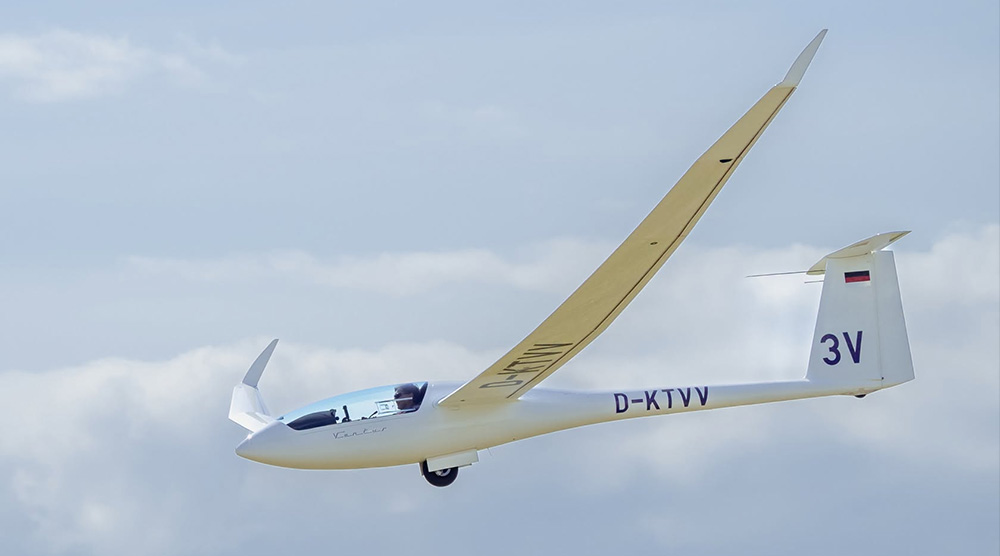
The third round of Series 13 of the FAI Sailplane Grand Prix took place at Elverum Starmoen in Norway from 28 June to 4 July 2026, operating out of the Ole Reistad Senter. Thirteen gliders lined up for the event, contested over Norway's characteristic mix of northern hills and mountains and softer flatland to the south.
The grid included Klaus Kalmbach and Michael Pfennig of Germany, Petr Panek of the Czech Republic, and a strong Norwegian contingent led by local pilot Arne Martin Güettler, alongside Jo Inge Bjørø, Kato Kvitne, Eirik Brenner Marthins, Rune Hovda and Steinar Oksenholt. The international entry also included Schempp-Hirth CEO Tilo Holighaus of Germany, Mikael Widén of Sweden, Teet Jagomägi of Estonia, Luka Žnidaršič of Slovenia, and Maciej Walasek of Poland. Starmoen had previously hosted the Grand Prix in 2024, when Germany's Conrad Hartter took the title ahead of Kalmbach and Güettler, and several of that year's competitors returned this time looking to improve on their result.
Holighaus opens with the fastest average speed of the week
Racing began on 28 June following two practice days. The task sent the fleet north for 261 km through Atna, Åkrestrømmen, Hovdedalen and N Løset before a run home via Hernes church, taking in views of the Rondane and Sølen ranges. A westerly wind and a cloud base forecast above 2,500 metres gave the fleet a fast day, with the leaders averaging close to 130 kph.
Tilo Holighaus took the win in his Ventus-3T, finishing in 2:02:59 at 127.5 kph. Petr Panek was second in the JS-1b JET, 3 minutes 20 seconds back at 124.1 kph, with Michael Pfennig third in the JS 3 TJ 18m, 7 minutes 7 seconds behind the winner at 120.5 kph. Norway's Kato Kvitne was best of the home pilots in fourth, and Teet Jagomägi rounded out the top five.
Güettler wins Race 2 Through Patience on Leg 4
Day two brought early uncertainty, with light rain leaving a roughly even chance of racing, before a usable window opened in the afternoon behind a passing cold front. Winds were awkward, gusting near 10 knots at low level with a steadier 20-knot flow higher up. The 150 km task ran Starmoen–Åsnes kirke–Holtet–Norhue–Hemsjøen–Hernes kirke–Starmoen, and all thirteen starters finished, though speeds varied widely leg to leg. Scoring speeds across the field clustered between 106 and 113 kph, with thermal averages around 2.0 m/s.
The race turned on Leg 4, the run to Norhue, where the spread between fastest and slowest glider reached 117.3 kph. Rather than press on immediately, Arne Martin Güettler worked with fellow Norwegians Kato Kvitne and Eirik Brenner Marthins to reach a known thermal source near Mt Holshaugen, taking the climb calmly before converting the resulting height advantage into speeds of 157.9 kph and 228.2 kph on the last two legs. He won by 37 seconds from Kvitne, who had the best raw climb performance of the day but lost time on Leg 4. Marthins took third, only 4 seconds behind Kvitne, having flown the most efficient race of the podium with just 12 climbs and 34 per cent of his time spent circling. Jagomägi and Rune Hovda followed in fourth and fifth. At the back of the field, Steinar Oksenholt brought his ASH 26E home in 13th, giving away considerable performance to the 18-metre fleet but completing the task regardless.
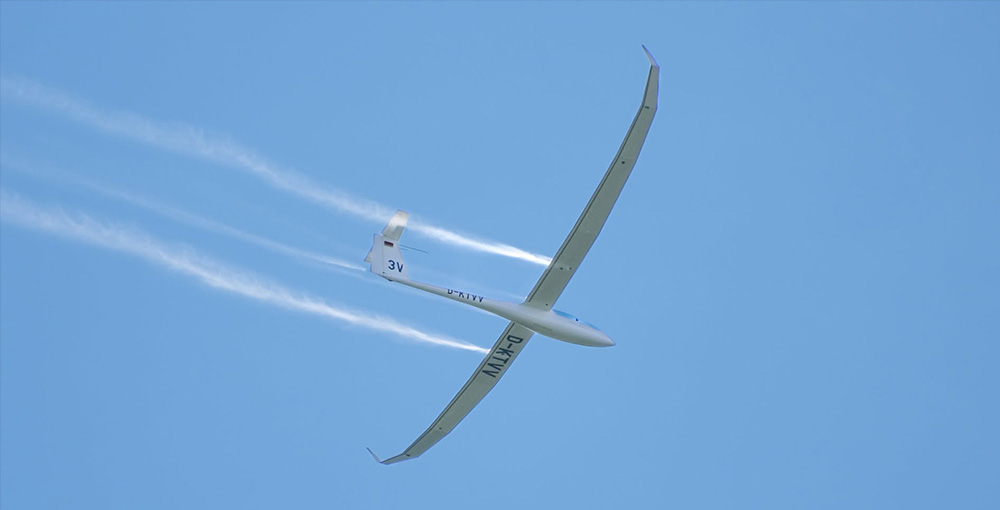
Güettler holds off Holighaus by 13 seconds
The best weather of the week arrived on 30 June, with forecasts pointing to cloud base above 2,600 metres and possibly beyond 3,200 metres, and light winds throughout. The task was extended to 353 km, taking the fleet deep into the Gudbrandsdalen valley past the Rondane and Jotunheimen national parks. The start gate opened at 12:50 local time, and eleven of the thirteen starters completed the course.
The opening leg to Kvam Kirke was closely matched, with finishers within 4.1 kph of each other, before Legs 2 and 3 opened gaps of 37.1 kph and 32.6 kph. Güettler flew consistently through the middle of the task, then chose a conservative line through the difficult Julussdalen sector on Leg 4, where the field spread by 47.3 kph, before finishing with 187.2 kph and 218.8 kph on the last two legs to take the win by 13 seconds from Holighaus. Holighaus recorded the best individual climb rate of the podium at 4.1 m/s and led Leg 3, but a final glide 14 kph slower than Güettler's cost him the top spot. Petr Panek took third, 1 minute 15 seconds back, having spent only 39 per cent of his flight circling. Klaus Kalmbach was fourth, having reached the highest altitude of the day at 2,424 metres. Teet Jagomägi recovered from a poor Leg 2 to finish seventh, posting the fastest leg of the day at 225.8 kph on the run home. Rune Hovda and Eirik Brenner Marthins both failed to complete the task, with Hovda using his engine to return to the airfield.
Holighaus takes the overall lead
Conditions turned more difficult on 1 July, with a low, broken cloud base and lift rarely exceeding 2.0 m/s. The 151 km task ran south through Gjesåsen kirke, Gjølstad flyplass, Storberget and Jømna, with a minimum finish altitude of 416 metres QNH. Scoring speeds across the field were tightly bunched between 91 and 105 kph.
The result hinged on Leg 3, the push from Gjølstad to Storberget, where Holighaus flew 153.8 kph against a field that was struggling to connect fragmented lift, opening a spread of 69.7 kph between the fastest and slowest gliders on that leg alone. He worked only eight thermals for the entire task and won in 1:26:23 at 104.9 kph. Klaus Kalmbach was second, 43 seconds back, having posted the best individual climb of the day at 2.6 m/s. Kato Kvitne took third after a notable tactical decision on the final legs, flying direct to the finish rather than following the terrain to the east and passing seven pilots in the process. Teet Jagomägi was fourth and Michael Pfennig fifth, only two seconds apart. Petr Panek finished sixth on raw time but was penalised 56 seconds for dipping 14 metres below the minimum altitude band near the finish, and Jo Inge Bjørø recorded the day's only DNF after crossing the line 45 metres below the minimum, outside the permitted tolerance. The result put Holighaus on top of the leaderboard with 30 points, ahead of Güettler on 28 and Kvitne on 23.
Weather stops play
Both 2 and 3 July were cancelled. On the second of these days, organisers tracked the risk of lightning developing over the airfield by mid-afternoon and judged that a fair and safe task could not be run. With flying suspended, the event used the time for a session on the Front Electric Sustainer and the developing E-Glide format, an interview with Holighaus on the aerodynamics of the Ventus 3, a discussion with FES developer Luka Žnidaršič, and a radio broadcast from the cockpit with Norwegian broadcaster NRK. Going into the final day, Holighaus led on 30 points from Güettler on 28, Kvitne on 23 and Kalmbach in fourth, still within reach of the podium.
Kalmbach wins the day, Holighaus takes the title
The final task on 4 July covered 222 km through Holtet, Haslemoen, Pramhussætra, Sigernessjøen, Gjesåsen and Jømna. Thermals again averaged below 2.0 m/s for most of the field, and scoring speeds clustered between 90 and 108 kph, rewarding consistency over raw speed.
Klaus Kalmbach won the race in 2:02:40 at 108.3 kph. The short 18 km Leg 4 to Sigernessjøen produced the widest spread of the day, 121.2 kph between fastest and slowest, and Kalmbach flew it conservatively at 75.1 kph before finishing with 160.4 kph and 197.0 kph on the last two legs. Maciej Walasek was second, 5 minutes 28 seconds back, having matched the fastest Leg 4 speed before losing time on Leg 6. Güettler took third, 33 seconds behind Walasek, recording the fastest leg of the day at 218.0 kph on the final glide. Michael Pfennig was fourth, six seconds further back, with a final leg of 213.8 kph of his own. Rune Hovda and Petr Panek both fell short of completing the course and used their engines to return.
With the daily race decided, attention turned to the overall result. Holighaus and Güettler finished the week tied on 35 championship points, and the title was settled on countback, with Holighaus taking the win and the qualifying place for the World Final in Chile. Kalmbach's final-day victory lifted him to third overall on 33 points. Güettler's second place on countback keeps him on the reserve list for Chile.
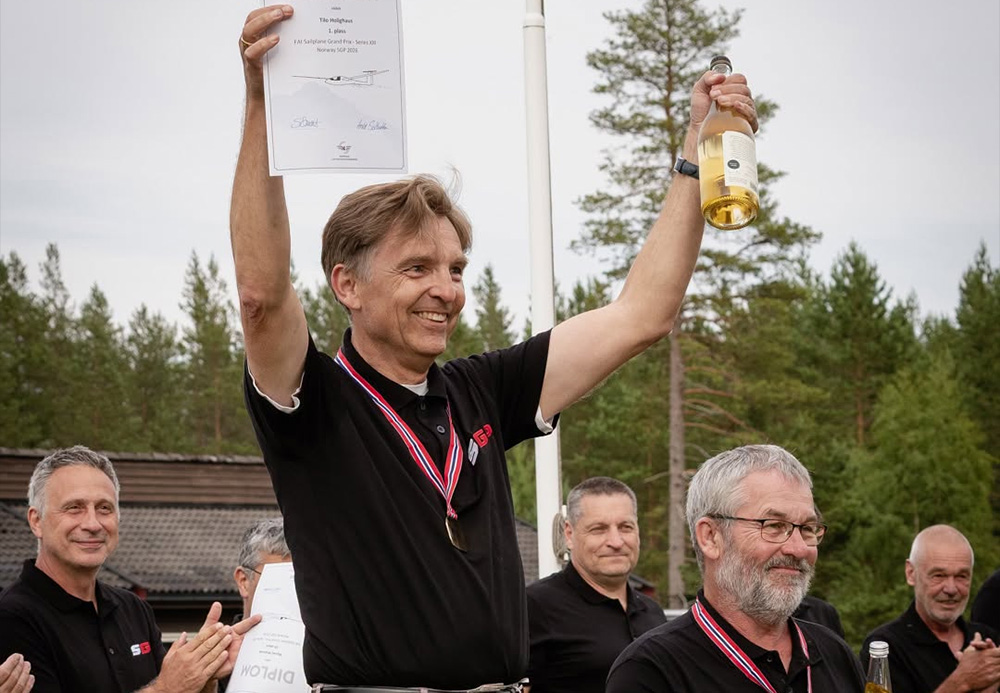
Final Standings
- Tilo Holighaus (Germany) – 35 points – Champion, FAI Sailplane Grand Prix of Norway 2026
- Arne Martin Güettler (Norway) – 35 points
- Klaus Kalmbach (Germany) – 33 points
Full recusts at sgp.aero
- Details
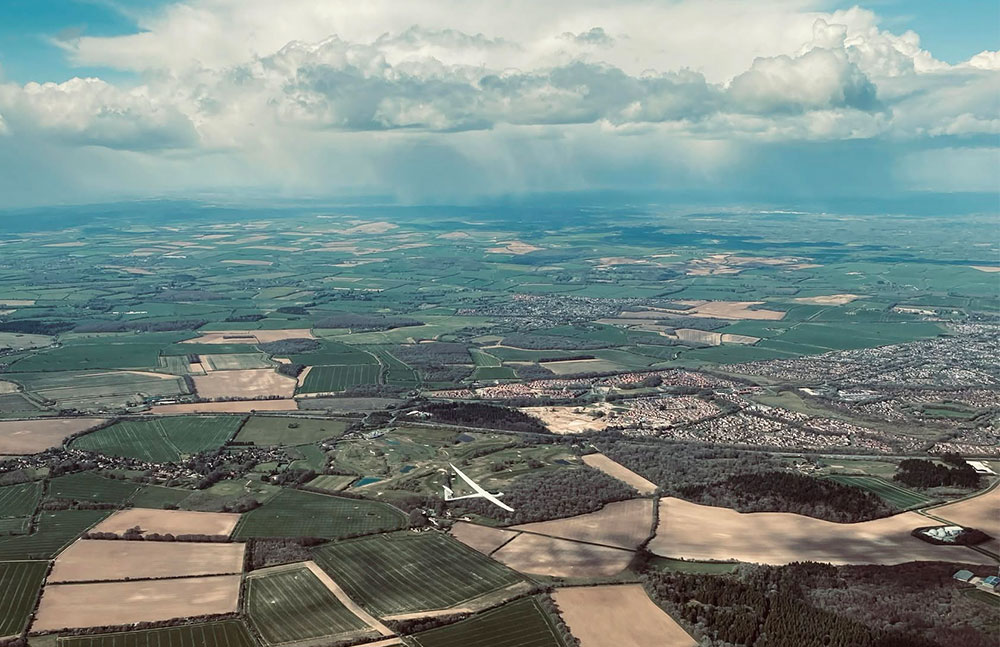
Lasham Airfield, Hampshire 5–13 June 2026
Tom Arscott took the top step at this year's UK Sailplane Grand Prix, held at Lasham over nine days in early June. Flying his Ventus 2a, Arscott accumulated 27 points across three scored tasks to claim the overall title ahead of Oliver Ramsay (LS8, 19 points) in second and Owen Mccormack (Ventus 2a, 11 points) in third. The event drew 20 pilots into the Sailplane Grand Prix class, competing over a run of tasks set in the Hampshire and Wiltshire countryside — when the English summer weather allowed.
Practice Day — 5 June
The competition opened with a practice task on the Thursday, giving pilots the opportunity to familiarise themselves with the local airspace and scoring system before points began to count. The route covered 183.41 km, taking gliders north past Oxford and across to Calvert before returning via Didcot and Candover Church to Lasham. Conditions were evidently difficult — only two pilots completed the full circuit. Howard Jones (Discus 2a) covered 85.88 km before landing out, while Hugh Miller (LS8) completed the task in 3 hours 29 minutes at 52.42 kph. Most of the field landed short of the first turning point, and several pilots did not get away at all. The practice day result carried no points toward the overall competition.
First Points on the Board 8 June
Sunday brought the first real racing of the competition. A 113.86 km circuit was set from Lasham, heading south-west to Salisbury Cathedral, then north to Mottisfont Station, east to Bullington, and finishing back via Candover Church. The window opened at 17:00, and starts were tightly grouped within a minute.
Tilo Holighaus (Ventus 3T) led the field home in 1 hour 24 minutes 50 seconds at a speed of 80.10 kph, earning the ten points available to the day's winner. Tom Arscott was second in 1 hour 34 minutes 43 seconds at 71.80 kph, taking eight points. Five pilots finished the full circuit in the competition window: Toby Freeland (ASG 29 15m) was third home at 69.74 kph, earning five points, while Stanisław Biela (Ventus 3TS), Owen Mccormack, Kim Tipple (ASG 29 15m), Neil Mclaughlin (Ventus 2a), and Wojciech Domański (Ventus 2a) all completed the course but received no points under the scoring structure.
The remainder of the field landed short. Oliver Ramsay, Henry Inigo-Jones, Howard Jones, Jez Hood, Björn Gintzel, Oscar Butlin, Paul Fritche, and Ayala Truelove all covered approximately 51–52 km before landing, suggesting the conditions deteriorated markedly somewhere out on the task. Ian MacArthur and Hugh Miller reached similar distances, while Nigel Mallender started very late and barely left the airfield circuit. Jan Knischewski did not fly.
After Task 2, Holighaus led the overall standings with 10 points; Arscott sat second with 8.
9 June: A Difficult Day Scored on Distance
Monday produced another marginal day. The task set was 116.38 km from Lasham to Newbury North, west to Marlborough, and back via Candover Church — the same route that would later be used for Task 4. No pilot completed the circuit, and all were recorded as Did Not Fly in the conventional sense, yet the day was scored using GPS logger data from the flight attempts, with positions determined by how far each pilot progressed toward the goal.
Oliver Ramsay was credited with first place and earned ten points, with Tom Arscott second on eight points. Ian MacArthur was third for seven, Kim Tipple fourth for six, Oscar Butlin fifth for five, and Owen Mccormack sixth for four points. Neil Mclaughlin took three points in seventh, Ayala Truelove earned two in eighth, and Stanisław Biela claimed one point in ninth. The remaining pilots received no score.
The result reshuffled the leaderboard considerably. Arscott, who had been runner-up on Task 2 and took eight more points here, moved ahead of Holighaus — who scored nothing on Task 3 — into the overall lead.
Task Cancelled
Wednesday repeated the same route as Task 3 — 116.38 km to Newbury North and Marlborough — and a group of pilots launched at 17:16, flying varying distances into the task. However, conditions did not allow completion and the day was cancelled with no points awarded. Ian MacArthur flew furthest, reaching 51.50 km, while several others made distances between 26 and 46 km before returning or landing out. Kim Tipple did not start. The cancelled day left the overall standings unchanged.
Task 5 — 13 June: The Final Day Decides It
The competition closed on Friday with its longest task of the week: 153.47 km. The circuit ran from Lasham to Newbury South, west to Andover SW, back to Lasham, out again to Newbury South, then to Andover SE, Candover Church, and finally home — a demanding double-leg route across the Hampshire countryside.
As on Task 3, no pilot completed the circuit, and results were again determined by a distance-based scoring of GPS data. Arscott was awarded first place and eleven points — the highest single-task score of the competition — with Ayala Truelove taking second and eight points, and Owen Mccormack third with seven. Björn Gintzel earned six for fourth, Stanisław Biela five for fifth, Jez Hood four for sixth, Howard Jones three for seventh, and Oliver Ramsay two for eighth. Paul Fritche picked up one point in ninth.
The eleven points from the final task proved decisive for Arscott, who ended the competition on 27 points overall. Ramsay's eight points from Task 3 and two from Task 5 gave him 19 in total for second place, while Mccormack's consistency across Tasks 3 and 5 saw him finish third on 11 points.
Full results and task details are available at soaringspot.com and the official results portal at crosscountry.aero.
- Details
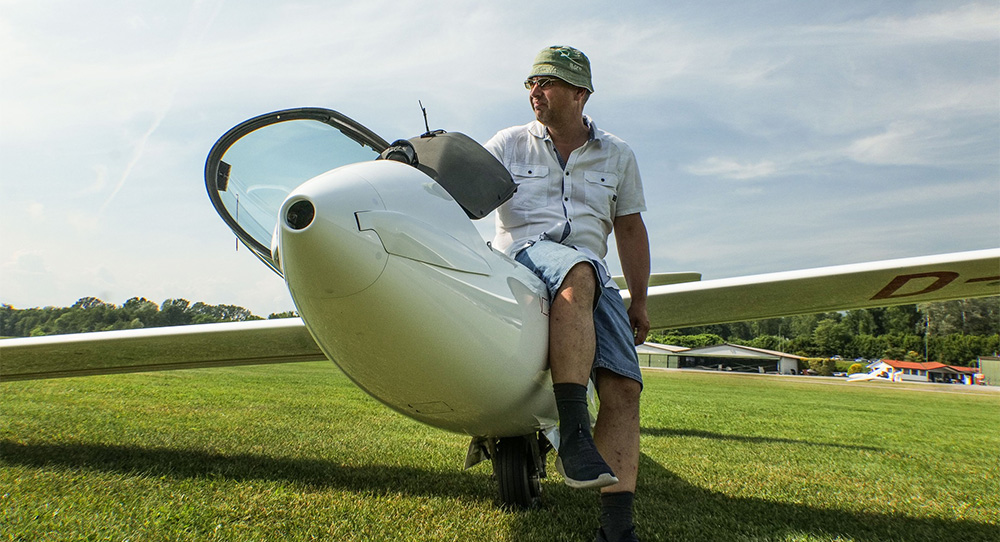
Luka Žnidaršič winner SGP Italy
SGP Series 13 Italy: Racing, Loss, and Resolve at Varese
FAI Sailplane Grand Prix — Varese, Italy, 22–30 May 2026
The 13th Series of the FAI Sailplane Grand Prix opened at Calcinate del Pesce, home of the Aero Club Adele Orsi (ACAO), with five races over seven days in the skies above Lombardy. What unfolded tested pilots not only as aviators but as people.
Race 1 — 24 May: Gatfield Wins the Opener
The competition began on Sunday 24 May with a 16-pilot grid and conditions that were weaker than forecast. A more stable airmass than forecast forced a tactical revision: the original task was set aside in favour of a compact 205 km "Task B" — Varese to San Pellegrino, then across to M Ceneri in Switzerland, back to Lasnigo, and home.
Slovenia's Jernej Lokovsek set a fast opening pace, crossing the start at 155 kph, but the weak conditions extracted a heavy price — he rounded the first turnpoint at just 397 m and eventually recorded a DNF, as did compatriot Luka Žnidaršič. The cross-border leg to M Ceneri became the day's decisive test, and the field thinned considerably.
Britain's Jon Gatfield, flying an AS 33 Es, navigated the Pre-Alps terrain with good judgement and connected with a useful energy line before the final glide, allowing him to separate cleanly from the struggling pack. He crossed the finish line in 2 hours 10 minutes and 38 seconds, averaging 94.2 kph with no penalty points. Germany's David Bauder finished second, 7 minutes and 46 seconds behind, with Italian local Stefano Ghiringhelli third, nearly 13 minutes off the pace.
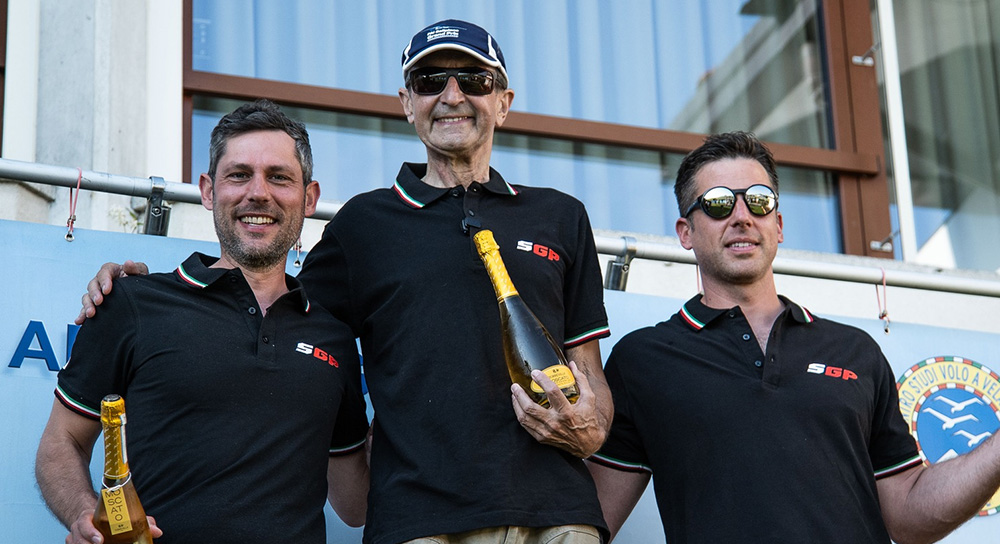
Jon Gatfield on th e podium after winning Race 1 SGP Italy. Requiescat in pace
A Tragic Loss — 25 May
On 25 May, during the second race of the competition, Jon Gatfield was involved in a fatal accident. Fellow pilots in the vicinity alerted organisers immediately, and a helicopter and emergency responders reached the site within minutes. Race 2 was cancelled and all remaining gliders directed back to the field. The following day, 26 May, was declared an official day of mourning.
Jon was a respected veteran of multiple SGP events and a highly accomplished pilot. He was widely regarded as generous, warm, and genuinely committed to the sport and its community. His loss cast a long shadow over the rest of the week.
Race 3 — 27 May: A Return to the Sky
After two days of silence, the pilots made a collective decision to return to the grid on 27 May. The atmosphere was quiet and subdued. Eight pilots chose to fly, seven of them electing to complete the designated task — a 227 km route across the ridges of the Lombardy region. Luka Žnidaršič, Michael Reiner, and Steffen Schwarzer completed the race and took the top three positions. The day was understood by all as a tribute rather than a competition, though the points counted.
Race 4 — 29 May: Žnidaršič Takes Control
Racing resumed in earnest on 29 May with a 219 km task threading through the Swiss-Italian lakes — Montevaltra, M Ceneri, Teglio, and Gurone before the return to Varese. It proved to be a highly selective day: only four pilots completed the task.
Luka Žnidaršič (LZ) won with an average speed of 96 kph, his advantage built primarily on the Ceneri-to-Teglio leg. While most of the field managed that section at between 47 and 48 kph, Žnidaršič found lines that allowed him to progress at 65.5 kph, then maintained 142 kph on the following leg to establish a lead the others could not close. Steffen Schwarzer (L7) and Michael Reiner (MR) crossed the line in the same second, exactly 34 minutes and 9 seconds behind, with David Bauder (DC) fourth, just 18 seconds later. Jernej Lokovsek fought hard to become the fifth finisher but fell short of task completion, having circled in 80 thermals at an average speed of 39.9 kph in difficult valley conditions. Ulrich Messmer (LR) and Maciej Walasek (M1) were unable to reach the Teglio turnpoint and did not complete the task.
Race 5 — 30 May: Reiner Closes Out the Week
The final racing day brought a compact 133 km foothill circuit through Lecco, Varese Arcisate, Brunate, and Gurone. A stable morning airmass required patience; the Race Director delayed the planned 13:00 launch and waited for conditions to develop.
Michael Reiner (MR) delivered the cleanest flight of the day, averaging 92.6 kph to take the race win. Žnidaršič was close behind, finishing 1 minute and 47 seconds later at 90.7 kph for second place. Steffen Schwarzer (L7) completed the podium at 87.6 kph.
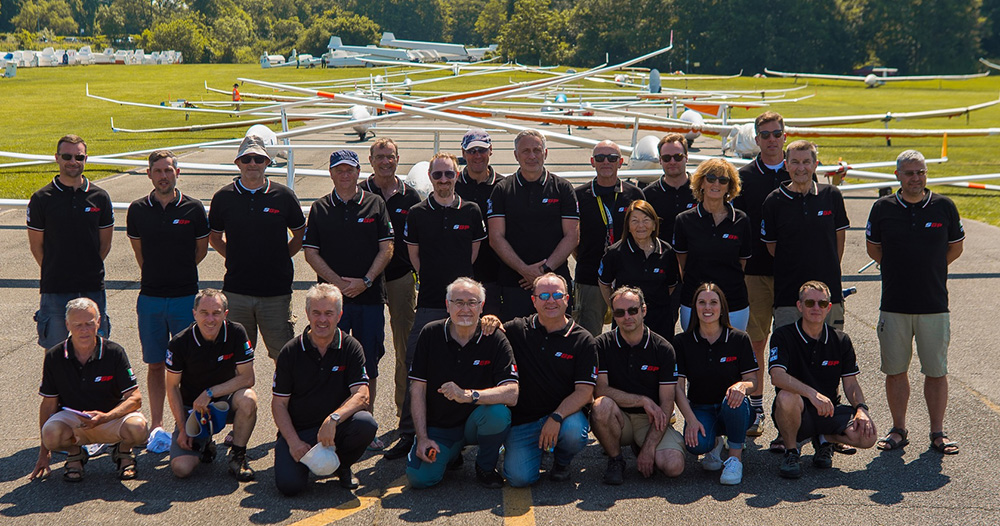
Competition Result
Through the five races, Luka Žnidaršič accumulated 19 points to win the Varese Grand Prix overall. Michael Reiner's consistent performances, capped by his final-race victory, placed him second with 17 points. Both pilots earned qualification for the SGP World Final, to be held at the Club de Planeadores de Chile in Vitacura.
The Varese event was the first qualifying round of Series 13. Further qualifying events are scheduled across 2025–2027, with the World Final in Chile as the series conclusion.
The SGP Series 13 Italian Grand Prix will be remembered as much for the collective decision to continue as for the racing itself. The pilots, organisers, tow pilots, and support crews chose to complete the competition in the face of genuine grief — a decision that reflected the character of the soaring community. The full series calendar and championship standings are available at sgp.aero
- Details