

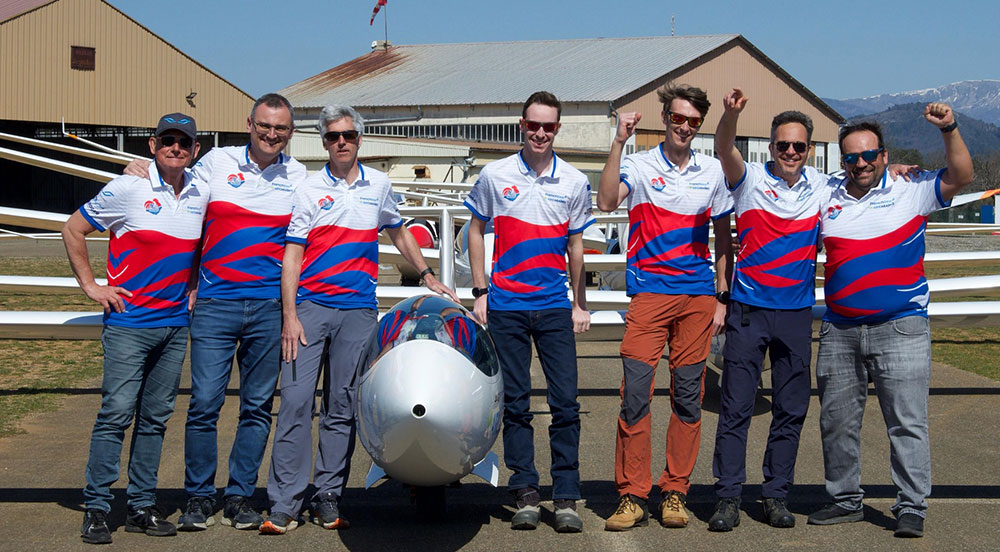
A season-opener in the Southern Alps delivers four tasks and a clear winner. The first Pôle France camp of 2026 ran from 13 to 22 March at Château-Arnoux-Saint-Auban. Twelve pilots gathered at one of France's most productive soaring sites for what organisers billed simply as the start of the racing and training season. The competition produced four scored tasks over nine days, with early spring weather dictating the flying calendar.
Équipe de France: World Championship Preparation Camp
Alongside the Pôle France competition, the week at CNVP also served as an intensive preparation camp for the Équipe de France ahead of the World Championship in May in Poland, where competition will be held across the 18m, 20m and Open classes.
The French squad pilots present were Sylvain Gerbaud, Laurent Aboulin, Christophe Abadie, Victor Mallick, Philippe Depechy, and Julien Duboc. Eric Napoleon served as team frame coach for the camp.
The agenda centred on three priorities: strategy, performance, and brand recovery. The programme was structured around:
The Setting
Saint-Auban sits at the confluence of the Durance and the Bléone rivers, surrounded by pre-Alpine terrain that reliably generates thermal and wave lift from late winter onwards. The airfield is home to the Centre National de Vol à Voile (CNVV), France's national gliding centre, making it a natural venue for squad training and early-season racing. For pilots flying in from flatter parts of France, the transition to mountain soaring — with its elevated start altitudes, narrow valleys, and unpredictable convergences — is itself part of the exercise.
The Field
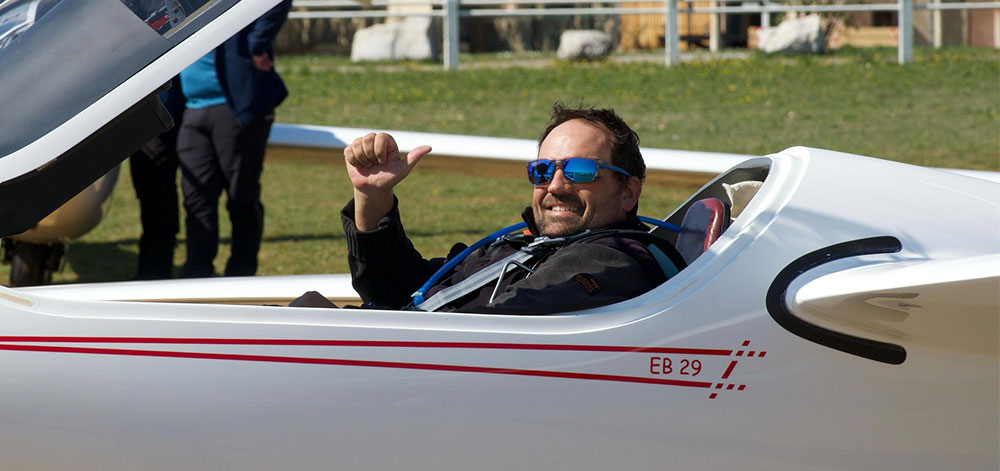
Twelve pilots entered across a range of Open and 18-metre class sailplanes. At the higher-performance end of the field sat Victor Mallick (JS3 18m) from Sarreguemines, Christophe Abadie (JS3 TJ 18m) from AAVE Buno Bonnevaux, Laurent Aboulin (JS1C 21m) from St-Gaudens, Théo Napoléon (JS1C 21m) from the local club at Château-Arnoux, and Sylvain Gerbaud flying an EB 29R out of Castelsarrazin-Moissac. The two-seater contingent was well represented by Francis Svobodny and Alexandre Fiérain sharing an Arcus M from Chartres and Abbeville, and Philippe de Péchy and Julien Duboc in an Arcus T from St-Sulpice and Condom.
Aurélien Doriat from Poitiers flew a Discus 2a, carrying a handicap of 109 against the 122 and above assigned to the JS3 variants. Sabine Dieulin flew both solo (Discus 2a, club Joinville-Mussey) and as part of a two-seat crew with Eric Napoléon in a standard Arcus. Jean-Emile Rouaux, flying for the home club at Château-Arnoux, operated an ASG 29 E in 18-metre configuration. Maxence Stawski from Fontainebleau-Moret flew the smallest-handicapped aircraft in the field, an LS 7 neo at 108.
The Tasks
Four tasks were set across the competition window, with five days producing no flying due to weather. All tasks were run under the FFVP Script 2026-100 format — a fixed circuit (course sur circuit imposé) with a Pre-finish Entry Verification (PEV) procedure requiring pilots to perform a designated holding pattern before the start gate opens. This system discourages early starts and rewards patience and precision alongside outright speed.
Task 1 — 17 March, 345.57 km
The first flying day sent pilots on a route via Mallefougasse, Castillon Barrage, Briançon, Col Cabre, and Digne before returning to Saint-Auban. The task was demanding for early-season mountain conditions, with a minimum distance for full scoring set at 350 km — just above the task length, meaning only finishers would approach maximum points.
Christophe Abadie took the day win, covering the circuit in 3 hours 58 minutes at 86.93 kph. Victor Mallick finished second, 18 minutes later, at 80.63 kph, with Jean-Emile Rouaux third in 79.56 kph — a satisfying result for the local pilot on home terrain. Francis Svobodny and Alexandre Fiérain were the fourth finisher at 73.17 kph, while Aurélien Doriat, Laurent Aboulin, and Philippe de Péchy all landed out short of goal.
Task 2 - 19 March, 503.43 km
The second task was the longest of the competition, a 503 km route via Mallefougasse, Sainte Victoire (near Aix-en-Provence), Aix-en-Diois, Castillon Barrage, La Cluse, and Digne. It was a significant step up in ambition and the field split sharply, with only three pilots completing the full circuit.
Mallick took the day at 111.42 kph, with Gerbaud close behind at 111.11 kph and Aboulin third at 111.04 kph — a remarkably tight three-way finish separated by under a minute over four and a half hours of flying. The remaining starters all landed out at various distances along the route. Svobodny and Fiérain, who had scored well on Task 1, reached only 136 km before landing, dropping them significantly in the overall standings. The Svobodny/Fiérain crew also collected a penalty for a PEV infringement on this day.
Task 3 — 20 March, 374.56 km
Task 3 routed pilots north and northeast into the higher Alpine terrain — via Mallefougasse, Le Logis du Pin, Col Granon (above Briançon at over 2,400 metres), La Cluse, and Savines before returning to Saint-Auban. This was the day's maximum scoring task, set at 1,000 points, and conditions appear to have been strong across the board with six finishers.
Aurélien Doriat won the day on handicap-corrected time, completing the circuit in 3 hours 42 minutes at a corrected 101.23 kph to score the full 1,000 points. Mallick and Abadie crossed the finish line within one second of each other — Mallick at 17:19:28 and Abadie at 17:19:26 — both credited with 976 points at 111.50 and 111.49 kph respectively. On raw speed they were faster than Doriat, but the Discus 2a's lower handicap multiplier lifted him to the top. Svobodny and Fiérain scored 932 points, De Péchy and Duboc 887, and Aboulin 854. Gerbaud and the Dieulin/Napoléon crew landed out short of goal.
Task 4 — 21 March, 362.55 km
The final task set a 362 km route via Mallefougasse, Aups, Col Tourniol, Gap, and Ganagobie Prieuré. Weather conditions were clearly more difficult on this day — only one pilot completed the full circuit, and the daily factor (Fcr) was reduced to 0.840, indicating fewer finishers than the threshold set for full scoring. With a maximum of only 915 points available and speed points reduced to just 122, distance points dominated the scoring for this task.
Svobodny and Fiérain were the sole finishers, covering the route in 4 hours 28 minutes at 80.94 kph for 769 points. Doriat placed second in the daily standings despite not finishing, reaching 259.42 km. De Péchy and Duboc were third with 263.92 km covered. Mallick had a difficult day, reaching only 169 km. Several pilots including Abadie, Gerbaud, Aboulin, the Dieulin/Napoléon crew, and Rouaux did not fly. Théo Napoléon and Maxence Stawski also recorded no flying days throughout the competition; the latter, along with Sabine Dieulin (solo), appeared only sporadically in the results.
Final Scores
Victor Mallick took the overall title with 3,004 points. His consistency across Tasks 1, 2, and 3 gave him a margin that the difficult conditions of Task 4 could not erase. Francis Svobodny and Alexandre Fiérain recovered strongly to finish second on 2,624 points — their Task 4 win, combined with solid results elsewhere, earned them the runner-up position. Aurélien Doriat placed third on 2,526 points, his Task 3 day win proving the foundation of a competitive overall result.
Christophe Abadie finished fourth on 2,374 points. His Task 1 win and strong Task 3 performance were offset by a relatively modest Task 2 result. Philippe de Péchy and Julien Duboc came fifth on 2,159 points, and Laurent Aboulin sixth on 2,049 — both pilots consistent mid-field performers across the tasks they completed.
Sylvain Gerbaud, whose EB 29R gave him the highest handicap in the field at 129, scored well on Task 2 but struggled elsewhere to finish seventh on 1,289 points. Jean-Emile Rouaux took eighth with 779 points, a creditable result given that his scoring was concentrated in a single task. The remaining pilots — Sabine and Eric Dieulin/Napoléon, Sabine Dieulin solo, Théo Napoléon, and Maxence Stawski — completed the field.
Observations
The competition illustrates the challenge of early-season Alpine soaring. Of nine competition days, only four produced taskable conditions, and even on flyable days the weather varied considerably in quality. Task 2 stands out as the most demanding. It was a 503 km route requiring sustained thermal conditions across a wide geographic area, yet three pilots completed it at speeds exceeding 111 kph — a useful indicator that the Provence and Drôme valleys were in good form that afternoon.
The use of the PEV start procedure featured prominently in the notes, with several penalties issued across the four tasks for missed or non-compliant PEV windows. For pilots less familiar with this start format, the Saint-Auban camp provides an early opportunity in the season to get the procedure right before higher-stakes competitions later in the year.
The next Pôle France camp is expected to follow later in the season as the CNVV programme continues.
Full task data, meteorological notes, and IGC files are available at soaringspot.com/en_gb/pole-france-chateau-arnoux-saint-auban-2026/