

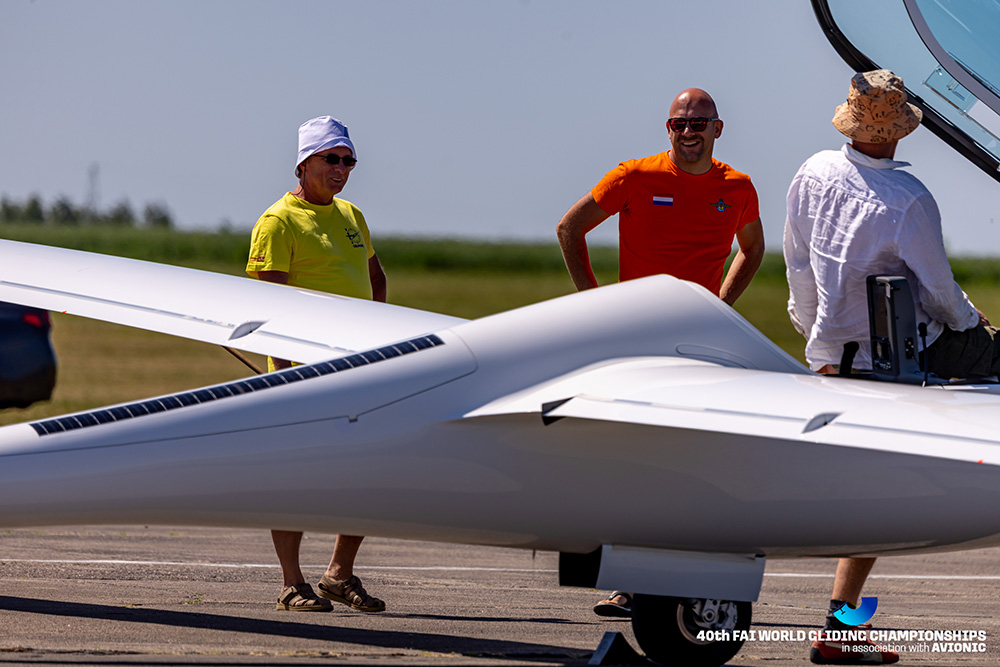
Three classes are scheduled to fly Task 8 today. The weather has improved and longer tasks have been set.
Open Class
The Open Class has been set a assigned task of 3 hours 30 minutes. The declared task distance from 219 ro 511 km,and a nominal task distance of around 362 km. Gliders will depart via a start line 10 km wide positioned 15 km to the south of the airfield, then head northwest to Ostrzeszów, which has a cylinder radius of 26 km. From there the route turns southeast to Panoszów (15 km cylinder), then north to Krzynno (18 km cylinder), east to Małuszyn (20 km cylinder), and finally back west to the home airfield cylinder of 5 km radius. The large observation zones on this task give pilots considerable flexibility in how they elect to use the airspace, and tactical decisions around cylinder entry points.
18 Metre Class
The 18 Metre Class has been set a task duration of 3 hours. Its declared distance is 460 km, with a shortest-path distance of around 161 km and a nominal distance of approximately 301 km. The start line for this class is 15 km wide (7.5 km radius), positioned to the northwest of the field. From there, gliders head further northwest to the STAR turnpoint, which has a large cylinder of 35 km radius — the biggest observation zone on any of today's tasks. The route then turns southeast to Panki (22 km cylinder), north to Beresie (18 km cylinder), east to Kotfin (10 km cylinder), and home via the 5 km finish cylinder.
20 Metre Multi-Seat Class
The two-seat class has also been assigned a 3 hour 30 minute task. Its declared distance is 494 km, with a shortest-path distance of around 210 km and a nominal distance of approximately 348 km. The start line is just 5 km north of the field. From there, gliders track east to Włoszczów (25 km cylinder), then northwest to the STAR turnpoint (35 km cylinder), southeast to Panki (20 km cylinder), east to Święta Anna (5 km cylinder), and then home. The STAR cylinder, shared with the 18 Metre task, is the defining feature of this route — its 35 km radius means gliders could potentially turn anywhere within a very wide band, and reading the day's conditions well ahead of that point will be important.