

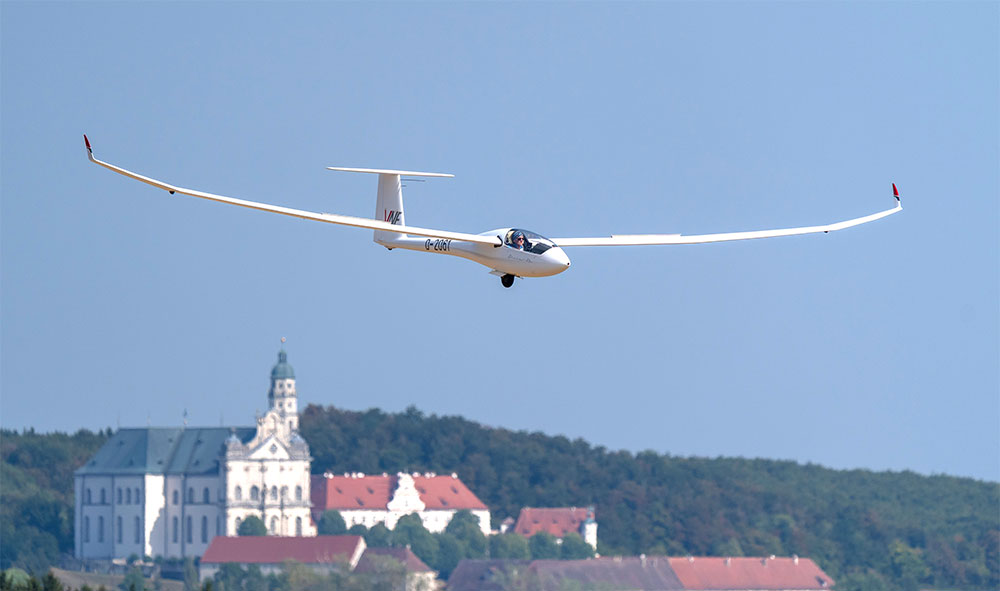
Heat Puts Young Glider Pilots to the Test over the Ostalb Elchingen
With two challenging days of competition, the 24th Junior World Gliding Championships at the Elchingen airfield have entered their most intense phase. Extreme temperatures, difficult thermals, and the first out-of-field landings demanded everything from the young pilots from around the world right from the first day. Following the opening ceremonies on Sunday in Neresheim and Aalen, the first scoring flights in the Club and Standard classes took place on Monday and Tuesday. The midsummer conditions with temperatures well above 30 degrees and a nearly cloudless sky, significantly hampered thermal formation in the morning. This made the tasks particularly challenging.
“The first day of competition always holds special significance at a World Championship. Of course, cooler temperatures and cumulus clouds would be ideal. But anyone who wants to become world champion must prove they’re the best under all conditions,” says Sports Director Bernd Schmid.
The sports committee therefore opted for so-called Assigned Area Tasks (AAT). In this format, pilots must cover as much distance as possible within a specified time. Instead of flying to fixed waypoints, the pilots navigate within large turning sectors and decide for themselves on where they turn. This requires constant tactical decision-making. In addition to searching for the best thermals, pilots must continuously reassess their speed, flight path and the behavior of their competitors. In the Club Class, the first task led from Elchingen to Ingelfingen to Rothenstein and back. Depending on the chosen route, pilots could fly between 138 and 327 kilometers. The Standard Class completed a task over the Hesselberg and Eichstätt, with distances ranging from 129 to 212 kilometers. Despite the difficult conditions, the gliders reached average speeds of more than 120 kilometers per hour.
Weather conditions remained a focus throughout the day. The German Weather Service supported the event organizers with up-to-date forecasts and issued warnings about thunderstorms in the evening. However, these passed southwest of the Ostalb in time. Nevertheless, the thermals proved to be extremely challenging especially for the club class. A total of 17 pilots had to make off-field landings at airfields as well as in meadows and fields. Several managed to reach the Bopfingen airfield—just a few kilometers from the finish line. On the second day of competition, the Club Class first flew to Blaubeuren, then to Treuchtlingen and back to the Härtsfeld. The Standard Class flew the route from Elchingen to Ingelflingen to Rothenstein. After two days of competition, Jan Stastny of the Czech Republic leads the Club Class ahead of his teammate Michaela Křížová. Nicolas Caudrelier of France is in third place. In the Standard Class, Barna Hadi of Hungary is in first place. His teammate Roland Veronyak is in second place ahead of Jacob Bøgelund Lassen of Denmark.
The weather is also expected to play a decisive role in the coming days. A cold front with the potential for thunderstorms is approaching the region. Competition Director Bernd Schmid is therefore coordinating the tasks on an ongoing basis with meteorologists from the German Weather Service. “If the weather becomes too hazardous, we’ll have to cancel a competition day. The safety of the pilots always comes first.”
Meanwhile, the atmosphere at Elchingen airfield is excellent. Teams and team captains from many nations are praising the organization of the World Championship by the many volunteers, primarily from the Heidenheim and Ostalb districts. Thanks to extensive coverage on social media, the international gliding community is now following the competitions in the Ostalb region. Elchingen once again is confirming its reputation as an outstanding host for top-tier international events. Results at soaringspot.com/de/jwgc2026/results
Michael Kost