

A Competitive Week Over Baden-Württemberg
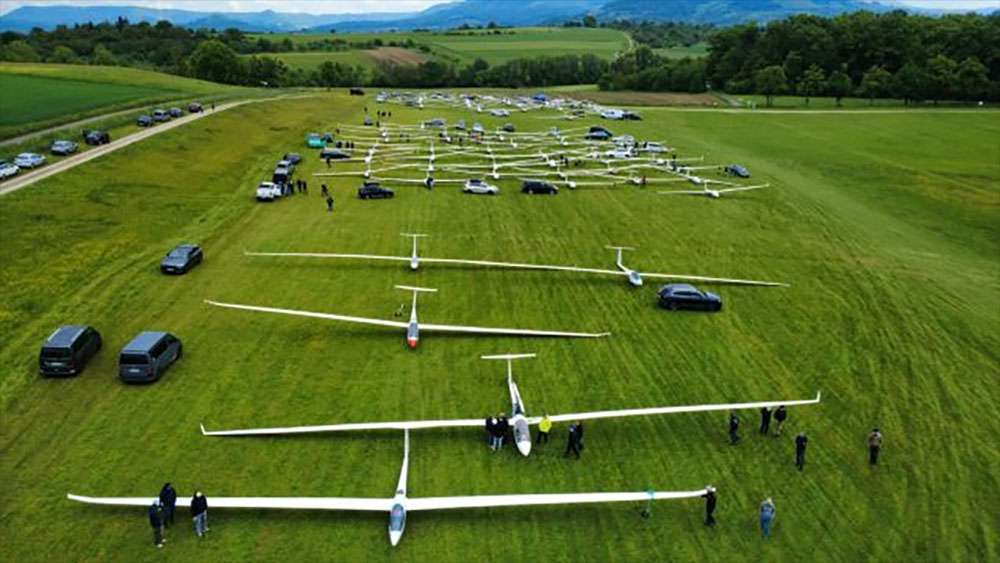
The 58th Internationaler Hahnweide Wettbewerb concluded on Saturday 16 May 2026 at Flugplatz Hahnweide, near Kirchheim unter Teck in Baden-Württemberg, southern Germany. Run by the Fliegergruppe Wolf-Hirth (FGWH), the event drew pilots from across Europe and beyond, with entrants representing Austria, Australia, Belgium, Switzerland, the Czech Republic, France, Germany, Italy, Lithuania, Luxembourg, the Netherlands, Poland, Sweden, Slovenia, the United Kingdom and South Africa. Competition was organised across four classes: 15m, 18m, Open (Offene) and Double Seater (Dosi).
The Hahnweide is one of Germany's most storied gliding venues. Sitting on a hillside plateau south-east of Stuttgart, the airfield has been hosting competitive soaring since the early days of the sport, and this year's 58th edition reflects the long continuity of the event. The surrounding landscape — rolling hills, the Swabian Alb to the south and the broad plains of the Neckar basin — provides conditions that can be rewarding and difficult in equal measure. That proved true again in 2026.

A Mixed Week of Weather
The competition ran from 9 to 16 May, and the weather was a constant factor throughout. The first competition day on 9 May produced racing in both the 15m and the Open and Double Seater classes, but several days that followed were disrupted or cancelled outright. Competition Day 3, on Monday 11 May, saw no gridding at all, with pilots instead gathering for a late briefing in the hope of an afternoon improvement that did not materialise.
When conditions permitted, tasks were set. The 18m class flew tasks ranging in declared distance up to around 362 km, with a minimum distance of approximately 140 km on shorter days. The 15m class flew an assigned-time task of two hours on the final day, with a declared distance of nearly 382 km in its maximum form and an optimised task distance of around 247 km. The final day, 16 May, brought rain and patchy skies. The Open class had its day cancelled while the other classes waited on the grid for a flyable window. When the 15m class was cleared to launch at around 1:30 pm, the other classes had already been stood down, and the task set for them was consequently a sprint to score before the prize-giving ceremony. Not all 15m pilots made it back to Hahnweide — the organisers noted at day's end that some had landed at other airfields or on farmland, while reporting that everyone was down safely.
15m Class — Jeroen Jennen Takes the Title
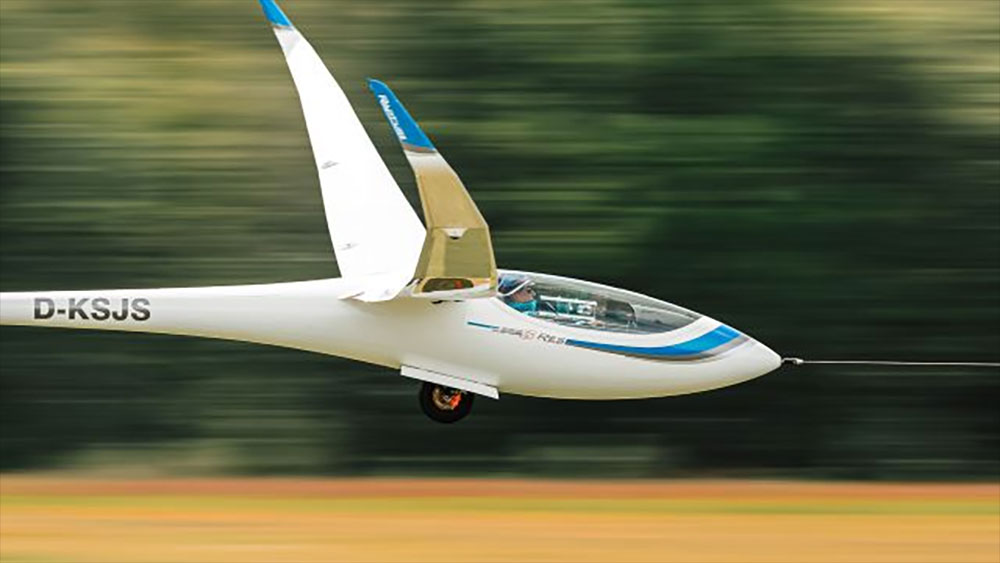
The 15m class attracted 26 pilots, with the competition running over three scoring days. Jeroen Jennen, flying an LS 8a for KonAck/LSV Viersen, took the overall title on 1,762 points. He was consistent throughout, placing third on Day 1 and then winning both the second and final scoring day. His final-day winning distance of 142.34 km reflected the abbreviated nature of the task.
Second overall was Eliott Daniel of France (AAVO), flying an LS 8/15m, finishing on 1,686 points, with Justus Sander in a Ventus 2ax completing the podium on 1,630 points. Notable elsewhere in the results was Aurélien Doriat, who won the first scoring day outright with 869 points but slipped back to fifth overall after a difficult second day. Tim Scott, representing Booker and flying a JS3 15m, was the leading British pilot, finishing seventh overall on 1,541 points. French pilots were well represented throughout the class.
18m Class — Bert Schmelzer Dominant
The 18m class ran over four scoring days and produced the clearest winner of the competition. Bert Schmelzer, flying a Ventus 3T/18m for SGKA/Kon. ACK, accumulated 2,832 points, more than 300 points clear of second-placed Sebastian Beule (Ventus 3M, LSC Bad Homburg) on 2,523. Schmelzer won Day 1 and Day 3, and on Day 4 — the most competitive speed day — he recorded a task speed of 129.28 kph, comfortably ahead of Malo Poulain de Saint Pere on 114.46 kph.
Third overall was Tijl Schmelzer (Ventus 3T/18m, LSV Viersen) on 2,430 points — with Bert and Tijl Schmelzer sharing the same glider type and club, that pairing occupied the top and third step of the podium. Noud Kaaij (ASG 29E/18m, VEZC) and Anne Ducarouge of France (JS3 18m, Nogaro) rounded out the top five, with Ducarouge a noteworthy performer in a class that fielded several JS3s and Ventus 3 variants. The class had 17 starters in total. Katrin Senne (JS3 18m, FSV Sindelfingen) finished 12th overall, one of several women to compete across the classes.
Open Class — Schwenk & Conway Edge Out Acketoft & Wendt
With only six entrants, the Open class provided closely fought two-seat and single-seat competition across three scoring days. The overall victory went to Schwenk & Conway, flying an eta for LSV Hayingen, on 2,463 points. They were pushed hard by the Swedish pairing of Acketoft & Wendt in an EB29DR, who finished just two points behind on 2,461 — one of the tightest margins of the competition. Acketoft & Wendt had actually won the second scoring day with a perfect 1,000-point score, but the overall difference came down to the first day, where Schwenk & Conway held a small advantage.
Third was Markus Frank (Nimbus 4DM, LSR Aalen) on 2,157 points. The gliders competing in this class — the eta, EB29DR and Nimbus 4 variants — represent the upper end of contemporary competition soaring, with wingspans ranging above 28 metres. The fastest daily task speed among Open class pilots was recorded by Jonas Zeller (Nimbus 4T) on Day 3, at 128.77 kph, ahead of Schwenk & Conway on 126.41 kph.
Double Seater Class — Bouderlique & Bouderlique Win in the Arcus
The Double Seater (Dosi) class was the largest of the four, with 20 registered teams, though one crew — Koch & Puskeiler — recorded zero points across all four days. The class was dominated by the Arcus M and Arcus T, with only a Duo Discus XL, a Duo Discus XLT and a single TwinShark providing variation. That uniformity made the contest a matter of pilot skill rather than equipment differentiation.
Bouderlique & Bouderlique (Arcus M, Amiens) won on 2,306 points, with Dierschke & Frank (Arcus T, AeC Bad Nauheim) a close second on 2,295. Theisinger & Frey completed the top three on 2,096. The fastest recorded speed day belonged to Laur & Schmidt (Arcus M, FSV Laichingen), who achieved 124.91 kph on Day 4. Several crews changed positions significantly across the four scoring days, giving the class its competitive character until the final results were confirmed.
International
The entry list recorded pilots from across Europe and from as far as Australia and South Africa — in keeping with the Hahnweide's long-standing draw as an open international competition rather than a purely domestic event. Across all four classes, approximately 70 individual pilots and crews took part, with France, Germany and the Netherlands particularly strongly represented.
The organisation, run by the FGWH in conjunction with the DAEC (German Aero Club) and the Baden-Württemberg aviation body BWLV, also provided live OGN tracking throughout the week, allowing supporters and interested pilots outside Germany to follow flights as they happened.
Final Results
15m: 1. Jeroen Jennen (LS 8a) — 1,762 pts; 2. Eliott Daniel (LS 8/15m) — 1,686 pts; 3. Justus Sander (Ventus 2ax) — 1,630 pts.
18m: 1. Bert Schmelzer (Ventus 3T/18m) — 2,832 pts; 2. Sebastian Beule (Ventus 3M) — 2,523 pts; 3. Tijl Schmelzer (Ventus 3T/18m) — 2,430 pts.
Open: 1. Schwenk & Conway (eta) — 2,463 pts; 2. Acketoft & Wendt (EB29DR) — 2,461 pts; 3. Markus Frank (Nimbus 4DM) — 2,157 pts.
Double Seater: 1. Bouderlique & Bouderlique (Arcus M) — 2,306 pts; 2. Dierschke & Frank (Arcus T) — 2,295 pts; 3. Theisinger & Frey (Arcus M) — 2,096 pts.
Full results, task sheets and pilot lists are available at soaringspot.com/en_gb/58-hww and the official competition website at wettbewerb.wolf-hirth.de