

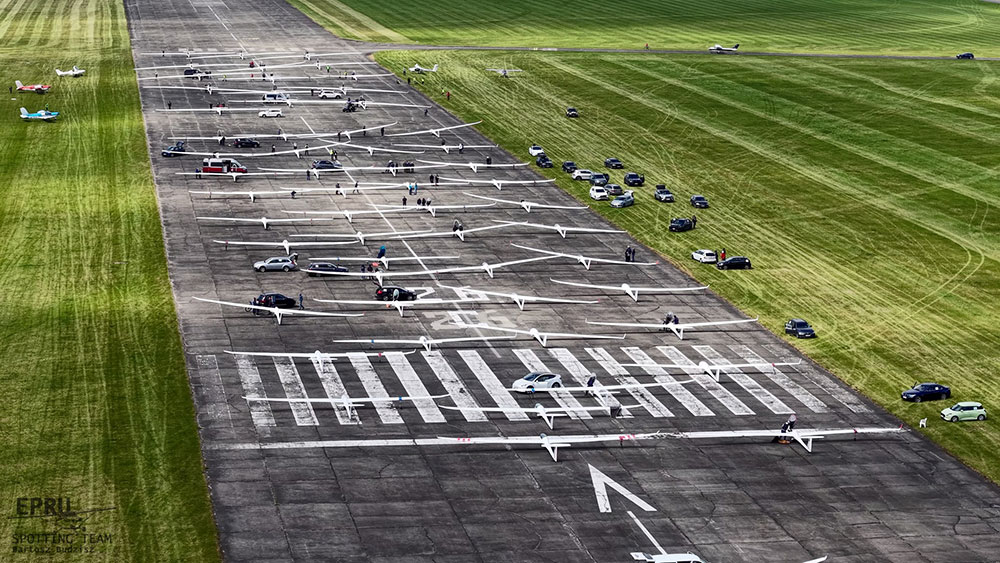
Race 1 19 May 2026
After two practice days WGC Poland flew its first scored task on 19 May 2026 from Częstochowa-Rudniki in southern Poland. All three classes — Open, 18 Metre, and 20 Metre Multi-Seat — were set Assigned Area Tasks, and the day produced some meaningful separation at the top of each class.
The first launches from Runway 26 was at 11:30. A range of Polish restricted areas had been deactivated for the day, giving competitors relatively open routing across the rolling agricultural country south and west of the airfield.
Open Class
The Open Class task was a six-turnpoint AAT set for a minimum duration of three hours, with a nominal distance of 383 km and an area range spanning from 273 km to 508 km depending on how pilots worked the cylinders. The route headed north-west to Szlark, south to Epop, north-east to Byczyna, east to Stobiecko, then home via a final gate east of the airfield.
Felipe Levin took the day win with 1,000 points, covering 382.25 km at 120.79 kph in 3 hours 9 minutes flying an EB 29R. Michael Sommer, also in an EB 29R, finished just 96 seconds behind on elapsed time but covered the full nominal distance of 383.62 km at 120.13 kph, earning 989 points. The gap between first and second was narrow enough that task speed rather than area exploitation proved to be the decisive factor at the top.
Third place went to Bas Seijffert (EB 29R) at 110.69 kph over 354.72 km, scoring 833 points — a more substantial step back from the leaders. Laurent Aboulin on a JS5 and Sylvain Gerbaud in another EB 29R were close together in fourth and fifth, both just below 110 kph.
Sebastian Kawa, flying a JS5 and competing on home soil in Poland, came home seventh at 104.73 kph. Russell Cheetham in the British JS5 finished tenth at 100.57 kph. The field spread down to Jan Buch-Madsen in fifteenth at 81.58 kph, reflecting either a more cautious routing or more difficult conditions later in the day for those who launched earlier.
The dominance of the EB 29R at the top of the result sheet was notable: six of the top nine finishers flew that type. The JS5 featured regularly through the mid-field.
18 Metre Class
With 42 competitors, the 18 Metre class was by some margin the largest of the three, and the task set a two-hour AAT over a nominal distance of 234 km, ranging from 166 km to 303 km. The route ran south-west from Kobylczyce to Komorzno and Dobry before returning via the eastern gate.
Aku Jaakkola from Finland won the class flying a Ventus 3T, completing 232.62 km at 116.09 kph in almost exactly two hours to take maximum points of 602. It was a precise piece of task management — flying almost exactly to the minimum time and hitting a speed that set the benchmark for the class.
Victor Mallick on a JS3 took second at 108.55 kph with 524 points, and Linas Miežlaiškis (AS 33 18m) was third at 107.63 kph with 514. Dennis Huybreckx and Christophe Abadie shared fourth place on 511 points, flying a Ventus 3T and JS3 TJ respectively, each at 107.3 kph.
American Sarah Arnold, flying a Ventus 3F finished seventh overall in the class at 106.00 kph for 497 points — a strong opening result. Australians Mark, Lumpy, Paterson (JS3 TJ) was seventeenth at 102.29 kph, and Norm Bloch (JS3 TJ) nineteenth at 101.41 kph.
The spread across the 42-glider field was considerable. Ronny Eriksson flew the longest route of anyone in the class, covering 253.32 km, but his elapsed time of 2 hours 39 minutes put him 35th. Antolín Javier Valdés Galera on a DG 600M finished last, taking 2 hours 49 minutes over 228 km for a speed of 80.77 kph. The DG 600M is an older design and the performance gap to the current generation of 18 Metre gliders is reflected in the result.
Two pilots received procedural notes: Kato Kvitne for a landing penalty and Takeshi Maruyama for an incorrect engine test procedure.
20 Metre Multi-Seat
The 20 Metre Multi-Seat class flew 16 crews on a two-hour AAT with a nominal distance of 217 km, ranging between 149 km and 287 km. The route followed a similar south-western arc to the 18 Metre task before returning to the airfield.
The class produced the tightest finish of the day. German crew Leucker & Omsels in an Arcus T won with 611 points at 109.66 kph over 222.33 km, just ahead of the British pairing of Jones & Coppin in an Arcus M — 610 points at 109.54 kph over 222.85 km. A 12-second difference in task time separated first and second despite Jones & Coppin actually covering fractionally more distance. Third went to Belgian crew Delfosse & De Broqueville at 108.21 kph.
The class was largely an Arcus contest — 13 of the 16 entries were Arcus T or Arcus M variants, with the remaining places taken by a pair of ASG 32 Mi gliders and a single HpH 304 TS flown by Swiss crew Girado & Bossart, who finished ninth.
The last-placed crew, Jakubcak & Sulirova in an Arcus M, still posted a respectable 97.72 kph for 478 points, illustrating the comparative consistency of the field in this class.
Overall Picture
Task One gave each class a clean, well-separated result. In Open, the EB 29R proved as competitive as expected at the very top, though the JS5 pilots will be watching closely as conditions develop over the next ten days. In 18 Metre, Jaakkola's near-perfect time management handed him maximum points on day one. In the 20 Metre class, the contest between Leucker & Omsels and Jones & Coppin was decided by seconds and will likely continue to be close through the remaining tasks.
The championship continues at Częstochowa-Rudniki through to 30 May, with up to ten further competition days available. Results and task declarations are published live at soaringspot.com.