

A Race Across Europe
Euroglide 2026: A Race Across Europe, Day by Day
Euroglide is not a contest in the usual sense. Rather than flying a fresh task each day from a fixed airfield, the field sets off once from Venlo, in the Netherlands, and has twelve days to round a set of turnpoints and get home however they can. Landing out is part of the plan rather than a failure of it. Teams retrieve, find a new airfield, and launch again, with strategy continuing long after the glider is back on the ground.
The 2026 edition, organised by the Venlo Eindhoven Gliding Club, launched on Monday 22 June and runs until Friday 3 July. The standard route this year, known as the Medium-Basis task, covers 2,546 kilometres, with six alternative versions held in reserve in case airspace or weather called for a change of plan. For the first time in the event's history, the route includes a turnpoint in Denmark, placed just inside the border because of airspace restrictions further north. Teams compete across three classes: pure gliders, turbos, and self-launchers, and each carries a credit of around 300 km that can be used to move the glider by road, by aerotow, or under its own power between legs.
What follows is a rundown of how the race has unfolded, day by day, drawing on the organisers' own updates and other reporting on the event. Euroglide is still in progress at the time of writing, with the picture for the back half of the field still developing, so this account will be updated as more becomes clear.
Day 1 — Monday 22 June
The race got away to a hesitant start. A sniffer glider launched at 11:45 to test conditions but found the blue thermals too weak to stay up. A second attempt an hour later succeeded once cumulus cloud began forming over Venlo, and the decision was made to send the self-launchers up. The first competitive take-off of the day came at 13:36, with the second wave of turbos and gliders taking around half an hour to grid. The last aerotow of the day went up shortly after 16:00.
By the end of the day, around thirty teams had reached Dahlemer Binz, just over the German border, while a handful of the faster crews had already pushed on as far as Pont-sur-Yonne in France. For an opening day that started in doubt, it was a solid result for the bulk of the field.
Day 2 to Day 4 — Tuesday 23 June to Thursday 25 June
Detailed day-by-day updates for the middle of the first week are limited, but the shape of the race over these days is reasonably clear from how the field had spread out by the time of the organisers' next public update. Getting clear of French airspace and terrain in the first two days proved to be the decisive factor for the leading teams. Crews who were slower to push through found conditions less forgiving as the days went on, with launch capacity around Besançon becoming tight for those arriving later.
By this point, a clear pattern had set in: a leading group making firm, well-timed calls on routing through France, where to overnight, and when to push on, with a much larger body of the field still working its way across the route behind them.
Day 4 to Day 5 — Thursday 25 June to Friday 26 June
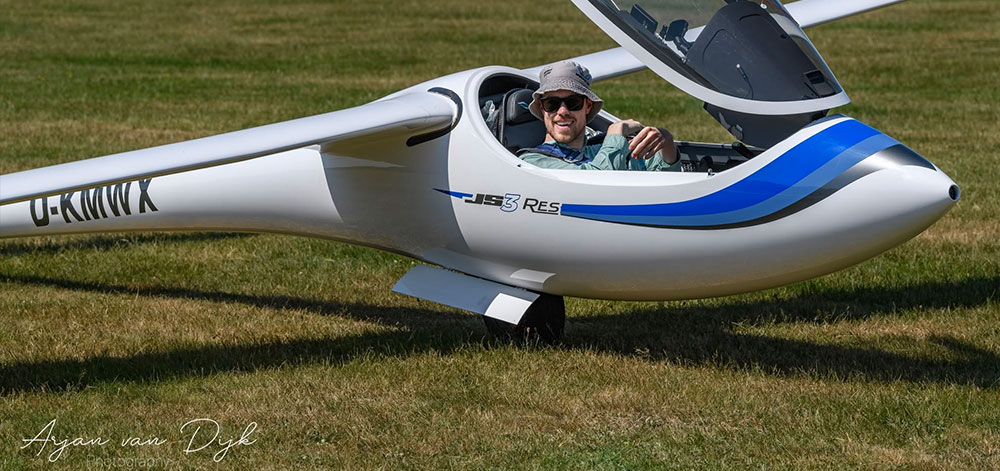
The race produced its first finishers, or near-finishers, around this point. Australian Matthew Scutter, flying a JS3, reached the closing stages of the course after four days of flying, with around 130 km left to run and an early-afternoon arrival back at Venlo Matthew won the contest for the second time having won in 2024.
This represents the sharp end of the field completing the 2,546 km course in roughly four to five days of flying, a pace consistent with past editions of Euroglide, where the fastest teams have generally finished in around five days while the bulk of the field takes considerably longer.
Day 6 — Saturday 27 June
By Saturday, the race had reached its halfway point in days, with six of the twelve available still to run. Activity on this day included a notice relayed through the shoutbox about Tábor in the Czech Republic being closed to traffic until 1 July, a reminder of how much of the day-to-day running of Euroglide depends on competitors sharing practical, on-the-ground information with each other. Team WK confirmed they were withdrawing from the race after an engine retraction failure following take-off, and arranged for a trailer to recover the glider.
With six days of racing remaining before the Friday 3 July deadline, the picture for the rest of the field, and how many gliders go on to complete the full course, remains open. Some teams will be closing in on Venlo, others will still be working their way across France, Germany, or the Czech Republic, and for many crews the outcome of Euroglide 2026 will likely come down to how the weather develops over the coming week.
A note on sources
This account draws on the official Euroglide 2026 website, the organisers' published news updates, alongside the event's published rules and task documentation and for the remainder of the competition, is necessarily incomplete. For full day-to-day detail, current standings, or confirmation of the eventual finishing order should check the live tracking and current edition pages at euroglide.nl/current-edition