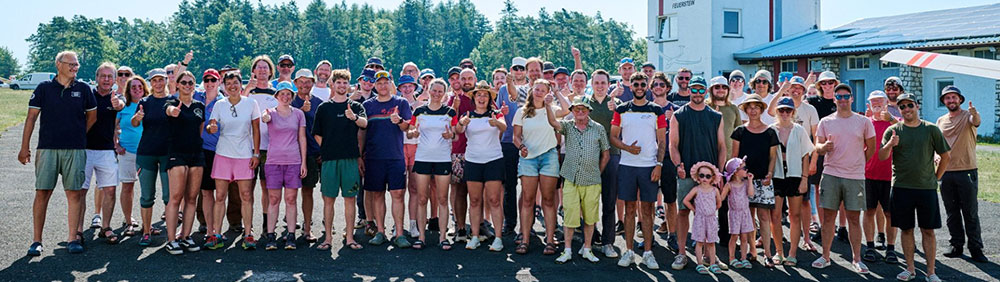

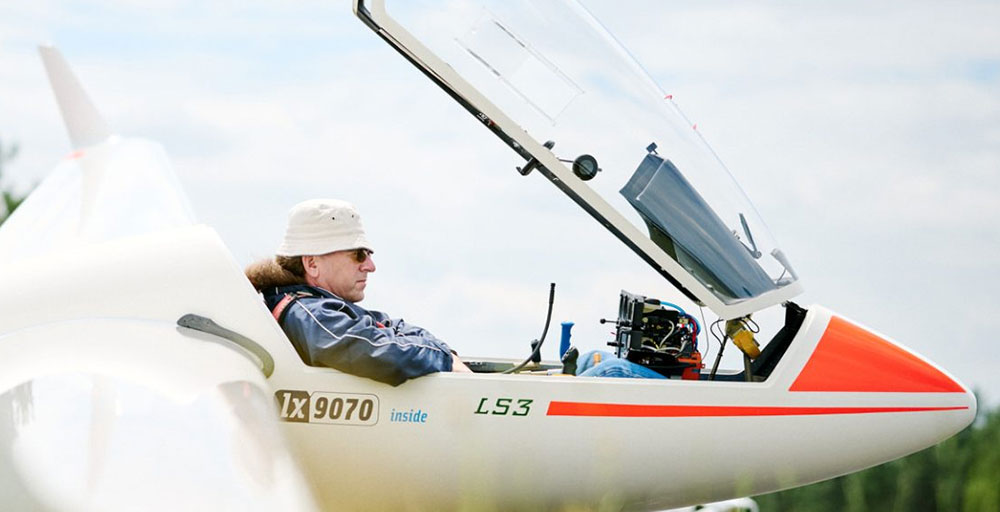
Pilots arrived at Burg Feuerstein into a wet westerly pattern, with showers, a fresh wind, and temperatures around 19°C. Forty-six pilots were entered, gradually arriving to set up caravans, unpack gliders, and work through documentation checks. The forecast pointed to unsettled weather through the week with an improvement expected from the Saturday, and a possible move into high pressure with temperatures up to 30°C in the second week of the competition.
First Race, 15 June — a 339 km race decided in the final kilometres
The first contest day set a 339 km racing task around four turnpoints: west from Burg Feuerstein to Frankenberg, down to Aurach, on to Waldenburg in the Hohenlohe plain, up to Wertheim on the Main, and home on a final leg of just over 100 km. The early kilometres required care, with the course passing beneath Nuremberg's controlled airspace.
The day turned into a duel between Brian Rechenberger and Uwe Wahlig, both flying the LS3, who matched each other almost exactly across the whole task. Rechenberger took the win by the narrowest of margins, 1,000 points to Wahlig's 991, with average speeds of 85.7 kph against 85.3 kph. Jürgen Jansen, flying an LS 1f, completed the day's podium in third.
Cooler air moving in during the evening took the strength out of what had looked like promising cloud, and a large part of the field landed out short of home on the long final leg. Eighteen pilots still made it back to Feuerstein over the full 339 km, a solid result given how the day closed out.
A look back at the figures from WeGlide showed the day had been won in the climbs rather than the glides. Rechenberger averaged 1.8 m/s in the thermals, the best of the day, while most of the field found only 1.3 to 1.5 m/s and circled for nearly twice as much of the flight. Some pilots further back in the order were faster between thermals than the leaders, yet still came home more than ten kph slower overall, since the time lost climbing back up outweighed any time saved gliding fast.
Wahlig answers back and takes the lead
After a cancelled day the second race was an Assigned Area Task across three sectors, from Feuerstein southwest toward Scheinfeld, north to the Zabelstein, and east to Scheßlitz, each a ten-kilometre cylinder, with a minimum task time of one hour forty minutes.
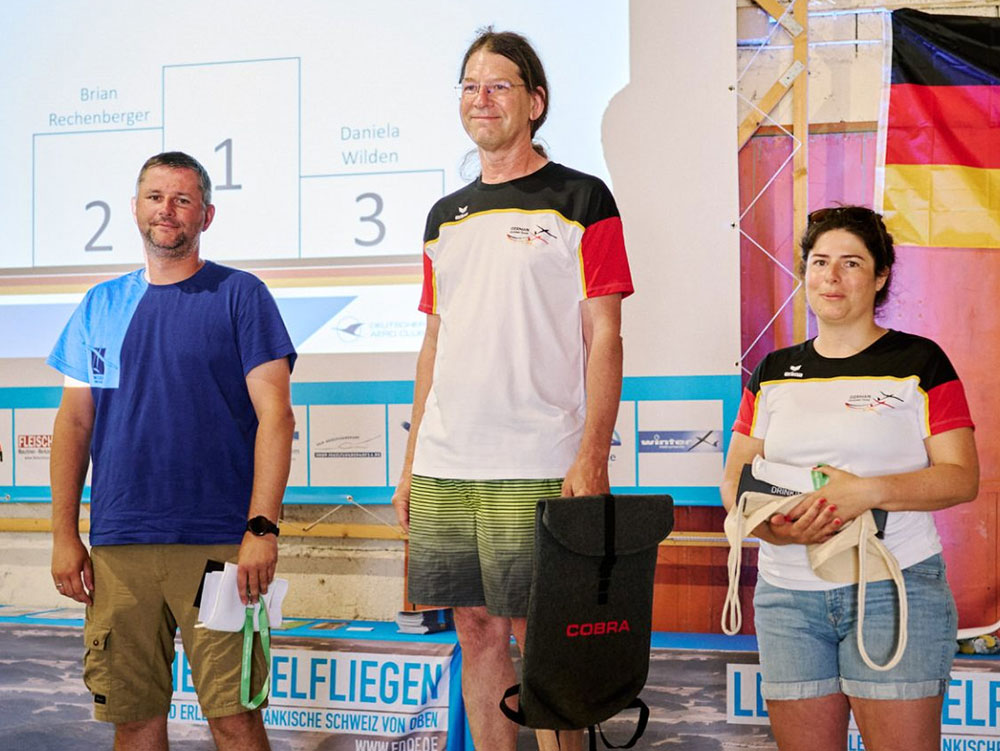
Uwe Wahlig, took the win at 88.0 kph ahead of Robin Förster and Frederic Weigert. Wahlig did not have the best average climb of the day, but had by far the best glide performance, finding the lines that kept him up and committing to a long final glide home.
The previous day's winner, Brian Rechenberger, landed out and dropped from first overall to thirteenth after a single outlanding. Thirty-three of forty-two pilots made it home, a good return given the conditions, though the day's points were tightly bunched at the front and spread widely further back.
Blue skies to the west for Race 3
The task was a 372 km race with no time limit: east to Amberg, out to Eslarn near the Czech border, then a long northwest leg of almost 150 km to Rodach near Coburg, on to Geiselwind in the Steigerwald, and a final run of just over 40 km back to the airfield. Forecasters expected a cloudbase around 2,100 metres with strong climbs near the airfield, but increasingly dry, blue conditions to the west along the long legs toward Rodach and Geiselwind.
Wahlig and Rechenberger again set the pace, this time flying the entire task alone and ahead of the rest of the field in a straight contest between the two. Rechenberger had the better average climb, 2.4 m/s against 2.2 m/s, but Wahlig countered with a glide advantage of around 14 kph at the same glide ratio, and a stronger final glide settled the result. Wahlig took the day, 1,000 points to 937, at 104.7 kph against 100.7 kph, his second win on the final glide in a row. With Rechenberger straight back into second after his outlanding the day before, the two pilots had clearly separated themselves from the rest of the field, though the overall placings below them remained unsettled.
Day 4, 19 June — a hunt that wasn't meant to happen
From outside, Wahlig's win looked like a calculated chase: start late, pick off the field one by one, take the day. From the cockpit it was closer to the opposite. Wahlig had intended an easier day flying with the group, but found nothing over the airfield and ended up 120 metres below the planned start height. With no time left to wait, he committed to pushing hard rather than drifting with the gaggle.
What followed suited his style: staying high by skipping any thermal under 2.5 m/s, climbing so efficiently that his altitude warning triggered repeatedly, and finishing with a bold final glide set on zero MacCready from Bayreuth home, taking every scrap of lift along the way. It was enough.
Rechenberger endured the same poor start, circling weakly for a quarter of an hour before pushing out at 1,900 metres "fed up," then finding strong climbs after that, including one section that went "like nobody's business." He felt he had flown well and matched Wahlig in the climbs and glides between thermals, yet finished around seven kph slower overall, with the difference coming down to roughly 13 kph more cruising speed for Wahlig between thermals, plus the longer final glide.
The halfway point
Reaching the midpoint of the championship, Race 5 rewarded pilots who flew with a clear plan and punished those who simply followed the gaggle. Robin Förster won by stretching his task line nearly 30 km further than the rest of the field and still posting the fastest speed of the day at 100.5 kph.
Behind him, Josh Jarosch and Fabian Käseberg flew a shared plan to second and third: an early start, the first turnpoint set tight to the corner at Grafenwöhr where they had found good lift on previous days, then a run down the inside line of a cloud street, finishing the last 35 km purely on glide with the final turn taken without circling once more. With the task an Assigned Area Task and minimum time acting as a floor, flying it down to the second without wasting time was the difference.
Selina Mihalyi produced the standout result of the day, climbing from forty-first on the previous day's scoresheet to the top five on this one, more than 35 places in a single day, with the second-fastest speed in the field at 99.7 kph.
Those who lacked a plan paid for it. Junior pilots Luis Zink and Hendrik Heckmann were drawn off course by the gaggle and fell behind, and six gliders, including the father-and-daughter Mosquito team of Jan-Hinnerk Scheel and Lilian Fröhlich, ended up crowded into the same fading thermal near Grafenwöhr.
Uwe Wahlig kept the overall lead, extending it to 3,858 points despite only a fifth place on the day. Leon Bohnenkamp made the biggest jump in the standings, rising to second overall without a single daily win to his name, while Frederic Weigert slipped to fourth after a weaker day.
Day 8, 23 June — flying alone pays off
After two days cancelled by rain Justus Sander, a junior and member of the national sports squad, won the day by deliberately not doing what the rest of the field was doing. While much of the gaggle gathered around Uwe Wahlig at the start line, Sander held back alone to the south for forty minutes, unable to see how many pilots had already started since he had no signal at the start line. He set off last, at 13:52, just as the lift over his position built again, and found what he called the best thermal he had ever climbed in Germany, enough to catch the gaggle by the first turnpoint.
From there it was a clean run home over a 246 km racing task, finishing at 101.5 kph, the fastest of the day. Hauke Schmoranzer missed the win by half a kph, with Daniela Wilden third, all three having flown the same way: late start, independent thinking, no following.
Uwe Wahlig, usually the pilot to beat, finished only twenty-first, not through any lack of speed but because he had company; flying with a large group meant flying only as fast as the slowest pilot in it. He kept the overall lead at 4,430 points regardless, while Sander's win lifted him onto the provisional podium in third. From second place down, five pilots were separated by only 32 points.
The longest task, the fastest day, and a 160 kph radio limit
At 438 km, this was the longest task of the championship, and despite grumbling at the morning briefing about its length, the field covered it at well over 100 kph, with the leaders at 110 kph across more than four hours of flying out to the Thuringian Forest and back, the fastest day of the competition.
Uwe Wahlig won again, this time by abandoning the tactically safer option of joining the gaggle at the first turnpoint. Seeing a gap in the cloud cover ahead on his weather display, he pushed on alone into the Oberpfalz instead, a decision he admitted afterward had felt reckless in the moment. It paid off: a single climb near the edge of the Frankenwald, and from there a smooth, fast glide most of the way home for a day's average of 110 kph.
Leon Bohnenkamp took second on the day after a tip from his coach the previous evening, to distract himself from the pressure of the overall standings by naming landmarks along the course as he flew. He also found one of the strongest climbs of the championship over the Thuringian Forest, a sustained 5.0 m/s. Justus Sander held onto third overall with a fourth-place finish on the day.
Wahlig's overall lead grew to 5,430 points, 439 ahead of Bohnenkamp, with places three through eight separated by only 126 points heading into the final two contest days.
A 457 km day, and the closest finish of the run
Cloudbase reached 2,800 to 2,900 metres, with conditions strong enough that one pilot covered the final stretch of his glide without circling at all. Uwe Wahlig won again, his third in a row, flying 457 km at 112.9 kph by taking a low line through the Oberpfalz close to the edge of controlled airspace at Grafenwöhr rather than the more conventional route, and finishing with a late surge in his final thermal that took him from a modest climb to the fastest speed of the day.
The closer story belonged to the pilot who finished second. Matthias Greiner flew around ten kph faster than the rest of the field on the glides, built a lead of around 40 km worth of time over four hours, and executed a plan to start last and collect the rest of the field along the way. Twice the day worked against him: once near Grafenwöhr, where he found strong lift right at the edge of restricted airspace but could not reach the better core of it inside the boundary, and once on the final glide, where starting it a few minutes too early cost him speed over the closing kilometres. The margin to Wahlig at the finish was 0.6 kph.
Daniela Wilden, flying with her partner Caro, again kept clear of the bigger groups with a late start and her own line, closing with a strong final climb and a fast run home. Leon Bohnenkamp had a harder day, flying well early over the Bavarian Forest but never regaining height afterward, and dropped to seventh overall.
Going into the final day, Wahlig led with 6,430 points, 517 ahead of Justus Sander in second, with Greiner, Schmoranzer, and a tight group of others separated by only 227 points across places two to eight.
The deciding day
The final task was a fixed 370 km course around five turnpoints: Großer Kornberg, Flossenbürg, Blessberg, Teuschnitz, and Gefrees, back to Feuerstein. No assigned area, no minimum time, pure speed around a set course for the full 1,000 points on offer.
Converting the gap between pilots into flight time showed just how close the standings remained. Second and third overall were separated by two and a half minutes. Places two through seven, six pilots, were separated by fourteen minutes, and the entire top eight by twenty-five. Only Wahlig held a comfortable buffer, close to an hour ahead of the field, needing only to finish the task safely while the rest had to attack.
Christopher Hanson won the day at 115.3 kph, the fastest of the field, taking an early, solitary route away from the main group to make the most of convergence lines, finding two clean climbs near Bayreuth and a useful thermal at the third turnpoint in increasingly blue conditions to the north. He finished around 70 km and a little over half an hour ahead of Wahlig by the latter's own account, and the result lifted him from sixth place overall into second.
Hanson's run to the podium had its own story behind it: an outlanding on the very first contest day had left him thinking the championship was over for him, before a steady climb back through the field across the following days brought him all the way onto the podium by the close.
Uwe Wahlig let the chasing pack go and came home ninth on the day, more than enough to secure the overall title with two days to spare in hand. He had waited at the start for cloud to develop further north and, in his own words, to let a few others get ahead of him first.
Justus Sander held off the closest pressure of the day to take the final overall podium place, having to fly carefully home on the last glide after arriving at the final turnpoint too low for an easy run.
Leon Bohnenkamp, who had spent much of the second week in the title fight, started too late on the final day to find the pace he needed and finished outside the medals, taking it without complaint as simply not his day this time.
Final result
Uwe Wahlig took the title with 7,288 points and five daily wins across the championship, finishing 484 points clear of the field with a steady, consistent run from the first contest day to the last. Christopher Hanson took silver with 6,805 points after his final-day win, and Justus Sander took bronze with 6,776 points at the age of 21, in his first senior national championship. Gold secures a place at the World Championship for Wahlig, with silver and bronze in line for the European Championship, and all three pilots earning a place in the national team.
The organisers closed the championship with thanks to the competition team for eleven days of running the event, to the pilots for disciplined and fair flying through to the last landing, and to Jürgen Wisbacher for leading the event as volunteer competition director.
Full results at https://www.soaringspot.com/en_gb/dmc2026-burg-feuerstein/