

Open Class
Kawa Flies to a Commanding Home Win on a Fast Day
The Open Class set a 537.62 km fixed-route task taking the field northwest to Biala, south to Bakowice, then a long leg east to Ossa before returning through Piotrkow and Swiercz to Rudniki. The optimum speed of 134.28 kph tells its own story — the conditions were markedly better than the previous day's assigned area task.
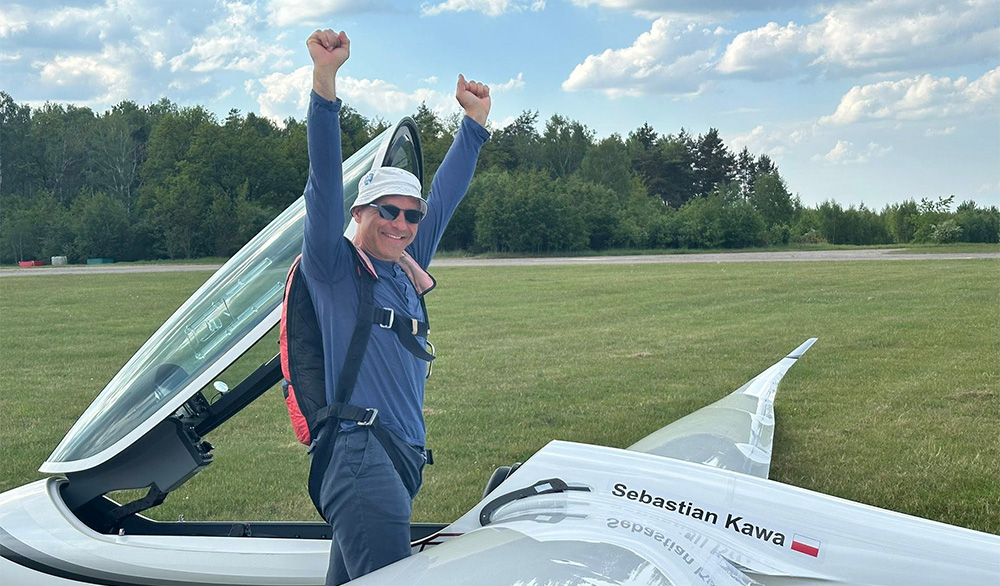
Sebastian Kawa, flying in front of his home crowd, took the day win in his JS5, covering the full 537.62 km in four hours and thirteen seconds at exactly 134.28 kph for maximum points of 1,000.
Argentina's Felipe Levin, the Task 1 winner, was second at 130.36 kph for 949 points, followed closely by Germany's Michael Sommer at 129.17 kph for 934 points. Czech pilot Tomas Rendla was fourth at 128.22 kph for 922 points, and Britain's Russell Cheetham fifth in a JS5 at 127.34 kph for 910 points. The top five were separated by less than fourteen minutes of flying time over a 537 km course, reflecting how closely matched the leading group is when conditions are good.
France's Sylvain Gerbaud was sixth at 121.22 kph, followed by the Netherlands' Max Leenders in an EB 29DR at 118.37 kph, Belgium's Pierre de Broqueville at 116.53 kph, Switzerland's Laurent Aboulin at 116.44 kph, and Czech pilot Christian Hynek at 116.29 kph — those three separated by under a minute across four hours of racing. Jiri Kusbach, David Jansen, and Oscar Goudriaan completed the full course clustered between 115.40 kph and 114.96 kph, meaning thirteen of the fifteen starters made it round.
The two who did not finish tell quite different stories. Bas Seijffert reached 501.85 km — agonisingly close to the finish — before his day ended, earning 394 points. Denmark's Jan Buch-Madsen, flying a JS3 RES 18m in a field otherwise dominated by EB 29Rs and JS5s, managed only 135.52 km for 106 points, suggesting an early difficulty that left him well short of the first turnpoint.
In the overall standings, Kawa's maximum-points day vaults him from seventh to 3rd place, while Levin and Sommer consolidate their places at the top of the leaderboard after two consistent performances. With the championships running until 30 May and many scoring days still to come, the Open Class competition is shaping up to be a close-fought affair between a group of pilots who are proving very evenly matched.
Boye-Møller Takes a Hard-Fought Win in 18m Class
The 18 Metre class flew the longest and most competitive day of the three classes on 20 May, with 42 pilots completing a 531.30 km racing task. The route ran northwest to Szlark, west to Murow, southeast to Jaksonek, south to Korytnica, northeast to Zytno, and home to Rudniki — a demanding course that nonetheless produced the fastest optimum speed of the day across all three classes at 136.45 kph.
Denmark's Arne J. Boye-Møller took the win in a JS3 TJ 18m, covering the 531.30 km in three hours, fifty-three minutes and thirty-seven seconds at 136.45 kph for 1,000 points.
Second place was shared by Germany's Mario Kiessling in a Ventus 3T 18m and France's Christophe Abadie in a JS3 TJ 18m, both credited with 965 points — their times separated by just two seconds after nearly four hours in the air, Kiessling finishing at 133.83 kph and Abadie at 133.81 kph. Britain's Victor Mallick was fourth at 133.11 kph for 956 points, and Lithuania's Linas Miežlaiškis fifth in an AS 33 18m at 132.39 kph for 946 points. The top five covered the 531 km course within seven minutes of each other, a measure of how closely matched the leading group was on a fast day.
Lithuania's Adomas Grabskis was sixth at 131.85 kph, followed by Sean Fidler USA at 131.65 kph and Germany's Stefan Langer at 129.62 kph. UKs Matthew Davis and the Netherlands' Thies Bruins tied on 904 points at virtually identical speeds — 129.21 and 129.18 kph respectively — rounding out the top ten. Czech pilot Alena Netusilova was eleventh at 129.00 kph, a strong result in a field of this depth.
The bulk of the field completed the course, with pilots spread across a wide speed range down to Sweden's Peter Johansson, who finished 38th after five hours and twenty-four minutes at 98.17 kph for 492 points. Four pilots did not complete the course. Finland's Petri Sucksdorff reached 496.23 km before the day ended, earning 371 points. Spain's Antolín Javier Valdés Galera in a DG 600M made 454.69 km for 340 points, Slovenia's Joze Verdev reached 311.82 km for 233 points, and Norway's Rune Hovda covered 234.19 km for 175 points before landing out.
Task 1 winner Aku Jaakkola of Finland had a difficult day by comparison with his opening performance, finishing seventeenth at 125.64 kph for 857 points after leading the class home on 19 May. With 42 pilots and championship still in its early stages, the overall standings will continue to shift as the conditions at Częstochowa dictate what kind of tasks the field faces in the coming days.
20 Metre Multi-Seat Class
Jones and Coppin Take Task 2 in a Long Day Over Poland
The 20 Metre Multi-Seat class completed a demanding racing task. The task covered 510.26 km across six turnpoints — north to Grabow, southeast to Lisowce, southwest to Wlodzimierzow, south to Pinczow, then back northeast to the East 20K point before returning to Rudniki. It was a genuine racing task with no area options, and with an optimum speed of just 99.26 kph the conditions were clearly not straightforward.
Britain's John Jones and Russell Coppin, flying an Arcus M, took the day win after five hours and eight minutes in the air, completing the 510.26 km at 99.26 kph for 625 points. It was a measured performance on a day that tested the entire field, and only seven of the sixteen crews made it around the course.
Poland's Grabowski and Czyż were second, also in an Arcus M, finishing around thirteen minutes later at 95.72 kph for 606 points. Netherlands Borgmann and Wolff (Arcus T) took third at 94.57 kph, with Italy's Ghiorzo and Gostner (Arcus M) just three seconds behind them in fourth at 94.29 kph. Germany's Leucker and Omsels, winners of Task 1, rounded out the top five at 93.74 kph, with all five separated by a relatively narrow speed band given the length of the day.
Australians Woolley and Gateley were sixth at 88.31 kph, and Hungary's Kassai and Mészáros seventh at 84.93 kph — both completing the full course but well adrift of the leading group, suggesting the conditions deteriorated or the routing proved more challenging for gliders that started on different lines through the task.
The remaining nine crews did not finish. Lithuania's Motuza and Volkov reached 465.83 km before the day ended, earning 404 points, while France's de Péchy and Duboc managed only 114.85 km for 100 points, suggesting an early problem or a difficult sector that stopped progress well short of halfway. Cronjäger and Blum, Lešinger and Grula, Girado and Bossart, Jakubcak and Sulirova, Delfosse and De Broqueville, and Janowitsch and Lutz all fell in the 82 to 100 point range, covering between 86 and 99 km before being unable to continue — a cluster of outlanders that points to a difficult patch of the course for those who encountered it at the wrong time.
With the overall standings now updated to reflect Task 2, Leucker and Omsels will have seen their early lead overtaken by Jones and Coppin's day win, and the competition has a long way to run with the championships continuing until 30 May.