

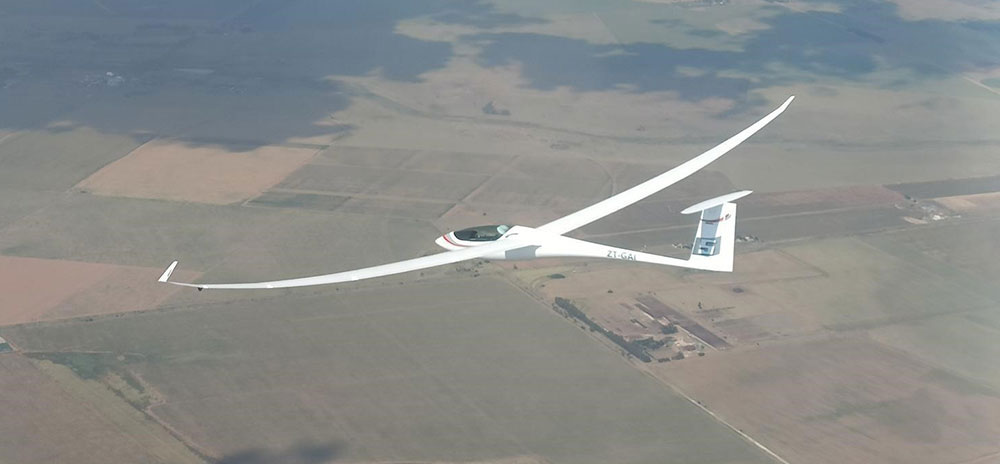
A New Contender Takes the Stage
The 40th FAI World Gliding Championships are underway at Rudniki airfield near Częstochowa, Poland, running from 16 to 30 May 2026. Three classes are being contested — Open, 18 Metre, and 20 Metre Multi-Seat — and among the most closely watched aspects of the Open Class competition is the continued emergence of Jonker Sailplanes' JS5 Rey. For many pilots, WGC Poland represents a fresh opportunity to see how the South African manufacturer's newest design fares against the established European competition on the world stage.
Background: Jonker Sailplanes and the Road to the JS5
Jonker Sailplanes, based in Potchefstroom, South Africa, has spent more than 20 years building a reputation for high-performance composite gliders. Their progression through the JS1, JS2, JS3, and JS4 models earned them a strong following, particularly in the 18 Metre class where the JS3 Rapture became a competitive force internationally. The JS5 Rey represents the company's return to the Open Class — a category the JS1 had previously competed in but where the newer, larger European designs had established a lead.
Jonker’s have indicated the goal was a glider that could climb well in small broken thermals while also performing strongly at high cruise speeds.
The JS5 Rey: What the Specifications Show
The JS5 Rey is a single-seat Open Class glider with a wingspan of 24.2 metres and a wing area of 13.2 m². The aspect ratio sits at 44.0, and the maximum all-up weight is 800 kg. Empty weight is listed as approximately 450 kg without an engine installed — a figure that reflects the emphasis Jonker placed on keeping the airframe light.
The glider claims best glide ratio of 69:1 at its 24.2-metre configuration, with a minimum sink rate of 0.45 m/s. At 200 kph the sink rate is listed as 1.32 m/s. Water ballast capacity is 199 litres. Maximum never-exceed speed (VNE) is 270 kph, with a maximum rough-air speed of 193 kph.
Jonker's design team, led by Dr. Johan Bosman, settled on the 24.2-metre span after extensive aerodynamic calculations. According to the company, extending the span further beyond 24 metres begins to introduce structural and stiffness challenges that actually reduce rather than improve performance, making 24 metres the practical optimum for this class of construction.
The wing design carries boundary layer control through blowholes or zig-zag tape, control surface gaps sealed using a Teflon/Mylar system, and integrated bug wiper garages. Two propulsion options are offered: a SOLO 2625-02i NEO Silent self-launching engine — a liquid-cooled, fuel-injected twin-cylinder unit producing 50 kW (64 hp) — or the MD TJ-42 jet sustainer. The cockpit follows the spacious layout established by the JS3, with in-flight electrically adjustable rudder pedals, an enlarged instrument panel, and a redesigned canopy mechanism.
The Competition: The EB29
Binder Flugmotorenbau's EB29 has been the dominant force in Open Class competition for some years, and its presence at world-level events has shaped how the class is understood. The EB29 is available in three wingspan configurations: 25.3 metres, 28.3 metres (standard), and 29.3 metres. This variable-span approach is central to the design philosophy, allowing pilots to configure the glider to suit conditions and competition requirements on a given day.
In its standard 28.3-metre configuration, the EB29 achieves a best glide ratio of approximately 66:1, rising to around 68:1 with the 29.3-metre tips installed. The 25.3-metre configuration produces approximately 63:1. Empty weight with minimal equipment is listed at around 580 kg, and the maximum ramp weight is 900 kg. Wing loading ranges from approximately 41.0 kg/m² at minimum to 54.5 kg/m² at maximum in the 28.3-metre configuration. The maximum speed is 280 kph.
The EB29 is constructed using high-modulus carbon fibre with vacuum suction manufacturing for the main structural components. Its wings use winglets at all span configurations and feature aileron and flap gap sealing with Mylar tape. Water ballast is distributed across inner and outer wing bags, with a fin tank available to manage centre-of-gravity shifts as wing ballast is adjusted. The engine is a SOLO 2625 02 driving a Binder BM-G1 propeller of 1.6 metres diameter, producing a climb rate under power of approximately 2.6 m/s.
There is also the EB29R variant, a further development of the baseline EB29 with refinements aimed at reducing weight and improving performance. Uys Jonker specifically referenced the EB29R as the benchmark the JS5 was designed to challenge.
A Direct Comparison
The most immediately obvious difference between the two gliders is wingspan. The JS5 Rey at 24.2 metres is considerably shorter than the EB29 in any of its configurations — around 4 metres shorter than the standard 28.3-metre setup and 5 metres shorter than the long-tip variant. This is a deliberate choice , and it produces a different set of trade-offs.
The JS5's claimed 69:1 glide ratio at maximum ballast is notably higher than the EB29's published figures, though direct comparisons between manufacturer-quoted glide ratios should be treated with care since test conditions and methodologies differ. What is clear is that the JS5 is designed to achieve its performance with a lighter, more compact airframe. The empty weight difference is substantial with the JS5 coming in around 130 kg lighter. For thermalling in marginal conditions, this lighter structure should into a lower minimum wing loading and improved ability to stay aloft in weak lift.
The EB29, by contrast, extracts performance through sheer span. At 29.3 metres its aspect ratio of 51.1 is considerably higher than the JS5's 44.0, which at equivalent speeds produces a lower induced drag penalty. In strong conditions on a fast day, the longer-span EB29R is a formidable machine, and its track record at world championships reflects that. The question the JS5 poses is whether the aerodynamic penalty of the shorter span is more than offset by the benefits of lighter weight and better handling in weaker or more variable conditions.
The cockpit comparison favours the JS5 in some respects. Jonker has worked to refine the cockpit through several iterations of the JS range, and the JS5 benefits from a widened instrument panel, improved canopy sealing, better wiring access, and a redesigned venting system. At 525 mm shoulder width it is among the roomier single-seat Open Class cockpits available, and the maximum pilot size of 2.03 metres means taller pilots are accommodated without modification.
Both gliders are certified to EASA CS-22 standards. The JS5 holds its type certificate through M&D Flugzeugbau, Jonker's EASA-approved design organisation partner in Germany, while Binder holds its own EASA certification directly.
WGC Uvalde 2024: The First Look
It is worth noting that the JS5 Rey is not technically a first-time WGC participant at the Poland championships. The FAI reported that the JS5 made its WGC debut at the previous World Championships in Uvalde, Texas in 2024, where four JS5 gliders competed in the Open Class alongside five EB29Rs and the remainder of the field flying JS1s, with the notable exception of the experimental Nixus fly-by-wire entry from Brazil.
At Uvalde, reigning World Champion Felipe Levin and previous World Champion Michael Sommer both flew EB29s and finished first and second respectively, demonstrating that the longer-span design in experienced hands remained the benchmark. The JS5 entrants — among them Attie Jonker, one of the designers — gained valuable competitive data from that campaign.
At Poland in 2026, the JS5 is again represented in the Open Class. Australia's David Jansen, as well as South African Oscar Goudriaan, previous World Champion Russell Cheetham from Great Britain, Laurent Aboulin from France and multiple World Champion Sebastian Kawa from Poland are all flying JS5s. A formidable group of pilots. But they will be competing agains an equally formidiible group flying EB29s including defending Open Class World Champion Felipe Levin and 2nd place winner and oprevious World Champion Michael Sommer from Germany.
What to Watch
The conditions at Rudniki near Częstochowa will play a significant role in how the two designs compare over the competition period. The region can produce strong, classic continental days that favour high cruise speeds and heavier wing loadings — conditions where the longer EB29 span historically performs well. However, it can also deliver the kind of fragmented, weaker thermal days where the JS5's lighter structure and lower minimum sink rate may offer a genuine advantage.
Both gliders are serious competition tools, built with careful attention to aerodynamic detail and structural efficiency. The Open Class has always been the arena in which manufacturers test the limits of what is aerodynamically and structurally achievable within the 850 kg maximum all-up mass rule, and the presence of both the JS5 and the EB29 at Poland ensures that competition remains a genuine contest of design philosophies as wel as pilot skill.
Results from the competition can be followed at soaringspot.com/en_gb/wgc2026