

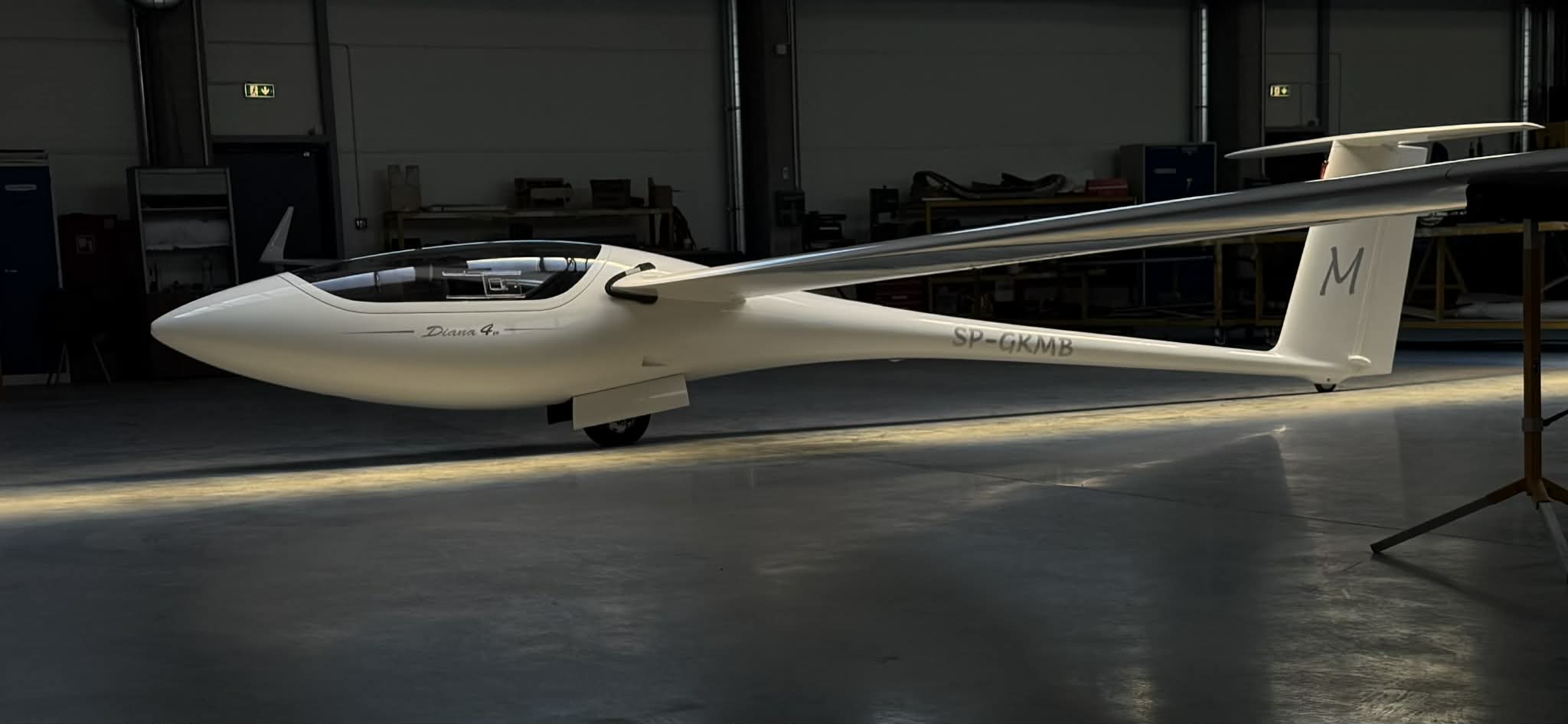
There is a particular kind of anticipation in the gliding community whenever a proven lineage produces something new. The Diana family, built on the competitive pedigree of the original 15-metre Diana 2, has earned that kind of attention. The latest aircraft from Polish manufacturer Avionic — the Diana 4 ER — is an 18-metre electric self-launching glider that represents the company's most ambitious design to date.
The Manufacturer Behind the Aircraft
Avionic was founded in 1997 in Górki Wielkie, Poland, originally producing trailers for gliders and ultralight aircraft. Over the years the company expanded into composite manufacturing, producing parts for the Extra 300 aerobatic aircraft and later for the Grob G 120TP turboprop. In 2016, Avionic acquired the production rights to the Diana 2 glider, and since then has developed the Diana 3 and now the Diana 4, growing the team to around 100 staff and approximately 2,500 square metres of production space.
The company has produced around 20 Diana 2 gliders since resuming production, and the Diana 3 — their first venture into the 18-metre class — reached a production run of three aircraft before attention shifted to the new design. Avionic is not a large volume manufacturer, and the Diana 4 is a high-performance product aimed squarely at the serious competition and cross-country pilot.
Why a New Design?
The Diana 3 used a fuselage sourced from Czech manufacturer KKB mated to Diana wings scaled up to 18 metres. It worked, but it did not include a retractable electric motor, something an increasing number of pilots now expect. Rather than retrofit a solution that the airframe was not designed for, Avionic started from scratch. The result is the Diana 4 ER — the ER suffix standing for Electric Retractable.
The aerodynamics were handled by Dr Krzysztof Kubrynski, who was also responsible for the wing profile of the Diana 2. The overall fuselage design is described by Avionic as aerodynamically optimised, with a noticeably sleeker cross-section than its predecessors. Sebastian Kawa, an eighteen-time world gliding champion who has repeatedly demonstrated the Diana 2's continued competitiveness at world championship level, served as both technical consultant and test pilot throughout the project's development.
Performance
The numbers Avionic and their Scandinavian distributor have published place the Diana 4 ER in genuinely competitive territory within the 18-metre class. The wing has an aspect ratio of 31.8 with an area of 10.2 square metres, and the calculated best glide ratio is 56:1. Wing loading runs from 41 kg/m² at lighter operating weights up to 59 kg/m² at the maximum take-off weight of 600 kg, which permits 195 litres of water ballast. The empty weight is 353 kg.
At maximum take-off weight, the aircraft is calculated to climb to 2,400 metres on battery power alone, after which approximately 130 km worth of range remains available for a return to base. Flying lighter, at 425 kg, the estimated battery climb altitude rises to 2,700 metres with around 150 km of level flight range remaining.
These are calculated figures, not certified flight manual data, so pilots evaluating the aircraft should treat them with appropriate caution until published flight test results are available.
The Electric Propulsion System
Unlike the Front Electric Sustainer (FES) system fitted to the Diana 2 FES — where the motor sits permanently in the nose — the Diana 4 ER uses a fully retractable system that folds flush into the fuselage when not in use. This is aerodynamically significant: a FES installation, however well designed, adds some drag whenever the aircraft is in gliding flight. A fully retractable system recovers that penalty, which is why the company developed their own propulsion unit rather than adapting an existing solution.
The motor delivers a continuous output of 23 kW, with a maximum burst of 44 kW available for up to two minutes — useful for rapid initial climb or to clear terrain. The 9.4 kWh battery pack is distributed across the wings, keeping mass close to the centre of gravity rather than concentrated in a nose-mounted installation. The batteries remain in the wings regardless of motor use, which contributes to the relatively wide ballast range.
Avionic describes the system as entirely in-house designed, which reflects both a technical preference and a practical reality: off-the-shelf self-launch solutions with full retraction are rare, and adapting one to a new airframe involves compromises the company chose to avoid.
The Cockpit
Avionic has taken a practical approach to pilot sizing. Rather than offering separate narrow-competition and wider-touring fuselage variants, the Diana 4 ER is designed with what the company describes as a universal cockpit intended to accommodate approximately 99 percent of pilots without modification. The cockpit is described as ergonomic with good access to instruments and adequate freedom of movement for extended flights. Two fuselage variants are available — a Competition cockpit and a Sports cockpit — giving pilots some choice based on their build and preference.
Pricing and Availability
The base price including the electric system is approximately €185,000 excluding VAT, according to Avionic. The Scandinavian distributor has quoted figures from €170,000 excluding VAT, suggesting some regional variation. By the standards of the current high-performance glider market, this sits within the range of other 18-metre competition aircraft, though it is a significant investment by any measure.
EASA type certification was in progress at the time of the manufacturer's most recent public statements, so prospective buyers should confirm the current certification status. Production of the Diana 4 ER was targeting deliveries from mid-2025, though buyers should check directly with Avionic for the current delivery schedule.
A Measured Assessment
The Diana 4 ER addresses a real gap in the market: a clean-sheet 18-metre self-launcher with a fully retractable electric system, designed by people with a demonstrable track record in high-performance glider development. The involvement of Sebastian Kawa from the outset, combined with Dr Kubrynski's aerodynamic work, provides some confidence that the design priorities are well understood.
The glide ratio figure of 56:1 deserves scrutiny once certified polar data is published — polar claims ahead of certification have occasionally proven optimistic in the industry — but the structural approach, the wing loading range, and the propulsion concept all appear sound on paper. For pilots competing in the FAI 18-metre class or flying long cross-country tasks who value self-launch independence, this aircraft warrants serious consideration once certified data and pilot reports from early deliveries are available.
Specifications cited in this article are from manufacturer and distributor materials and should be verified against the approved flight manual once EASA type certification is complete. Prospective buyers are encouraged to contact Avionic directly at avionic.com.pl for current pricing, certification status, and delivery schedules