

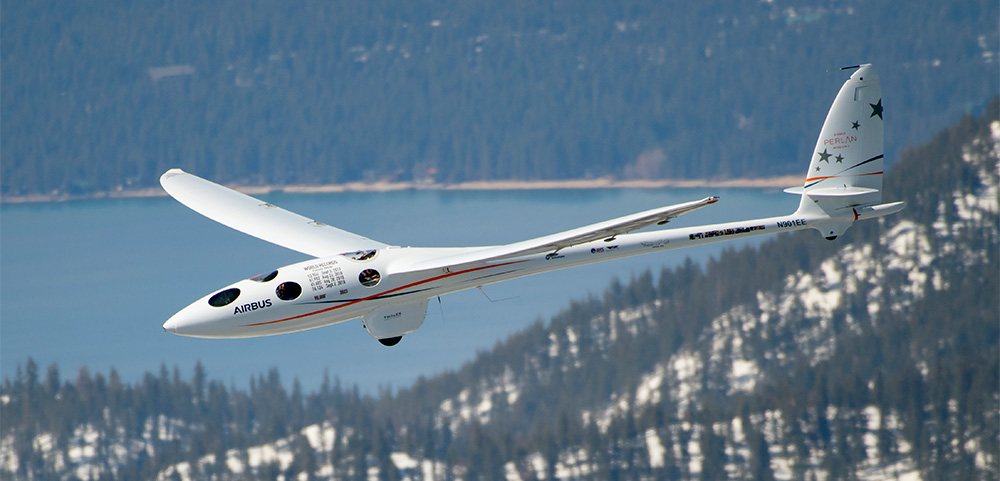
The Perlan Project has recently announced a leadership transition. Warnock has been named CEO Emeritus, a recognition of his long service to the organisation. Dr Elizabeth Austin, who served as the project's chief meteorologist and has been integral to its atmospheric science work, has been appointed as the new CEO. Michael Battalia joins her as President, and Jim Payne — the Perlan 2's chief pilot who set the 76,124-foot record — continues as Chairman of the Board.
Warnock served as CEO for roughly fifteen years, across two distinct phases of the programme: the development and construction of the Perlan 2, and the flight campaign that produced the altitude record. He did so as a volunteer, fitting the role around his academic and consulting work.
For glider pilots, the Perlan Project represents something that soaring has not often had: a research programme that places gliders at the frontier of what aircraft can do, in conditions that powered aircraft have never matched without engines. Warnock understood that from the moment he read about it in a magazine. His contribution was to make sure the organisation had the structure, funding, and strategic focus to keep flying.
The Perlan 2 is still sitting in a hangar, waiting for the polar vortex to build, and the 90,000-foot target is still unclaimed.

Top row left Perlan Project Chairman JimPayne, bottom row middle Ed Warnock
Ed Warnock and the Perlan Project
Ed Warnock did not arrive at the Perlan Project by accident. His path to leading one of the most technically ambitious soaring programmes in history was built over decades, shaped by aerospace engineering, bush flying, academic teaching, and a lifelong pull toward the sky. When the Oregon-based professor and consultant stepped into the role of CEO of The Perlan Project around 2010, he brought with him a career that had taken him from the deserts of California to the jungles of the Philippines and the plains of Africa — always, eventually, returning to aviation.
Warnock earned a Bachelor of Science in Aerospace Engineering with honours and high distinction from the University of Arizona in 1968, and later completed a Master of Arts in Organisational Systems Renewal at Antioch University. His first encounter with gliding came while working as a research engineer at the Naval Weapons Center at China Lake, California, where a colleague named Bertha Ryan took him for his first glider flight. It was a moment that stayed with him. After his time with the Navy, he left mainstream engineering to work as a pilot and mechanic with JAARS, a missionary aviation organisation, flying in the Philippines and in Sudan, Africa. He returned to the United States, built a career as a management consultant and strategy educator, and eventually found himself reading about the Perlan Project in Soaring magazine at his home in Oregon.
"When I learned somebody was going to attempt to go to the edge of space in a glider," Warnock later said, "I wanted to be part of such an interesting project. It tickled my interest in research and science." He volunteered for the CEO role, describing the project at the time as the most interesting aerospace programme on the planet.
The Project He Inherited
The Perlan Project was founded by Einar Enevoldson, a former NASA test pilot who had become convinced that gliders could be used to ride stratospheric mountain waves to altitudes far beyond the reach of conventional powered aircraft. In 2006, Enevoldson and adventurer Steve Fossett demonstrated the concept with the original Perlan 1 glider, reaching 50,722 feet over the Andes Mountains in Argentina — setting a world altitude record for a glider at the time. Fossett disappeared the following year while flying a light aircraft over California, and Enevoldson was left to keep the project alive and find the funding to build a more capable successor.
By the time Warnock took the helm, the organisation was developing the Perlan 2, a pressurised two-seat research glider built from carbon fibre, with an 84-foot wingspan and a total flying weight of around 1,500 pounds. The glider has no engine. To reach extreme altitudes, it relies entirely on stratospheric mountain waves — a phenomenon that forms when mountain winds interact with the polar vortex, creating powerful upwellings of air that can carry a glider far above the reach of any jet. The Perlan 2 is equipped with a closed-loop oxygen rebreather system, a passive cabin pressurisation arrangement that avoids the need for heavy compressors, and a wave visualisation system to help pilots locate rising air. Warnock described it as "a space capsule with wings."
The glider operates from El Calafate in the Patagonia region of Argentina, one of the few places on Earth where high mountains near the poles combine to generate the conditions needed for stratospheric mountain waves of sufficient strength. The flying season runs from roughly late July to mid-September, when the Southern Hemisphere polar vortex is most active. It is seasonal, weather-dependent, and logistically demanding work for an entirely volunteer team.
Securing the Future
One of Warnock's significant contributions as CEO was bringing in the sponsorship that allowed the Perlan 2 programme to move forward. In 2014, Airbus became the project's lead sponsor — a partnership that provided both financial support and engineering credibility. The Perlan Project became formally known as Airbus Perlan Mission II. Warnock applied the strategic management disciplines he taught in his executive MBA classes directly to the challenge of running a non-profit aerospace research organisation, managing fundraising, logistics, public communications, and the complex coordination of a volunteer scientific team drawn from across the aviation world.
"Over the past decade, we have been on a thrilling adventure to inspire, educate and explore in the stratosphere," Warnock said in 2023, "and Airbus has been a great partner on that journey as together we've attempted — and achieved — the seemingly impossible."
Breaking the Record
The project's defining achievement came in September 2018. Flying out of El Calafate, chief pilot Jim Payne and co-pilot Tim Gardner rode stratospheric mountain waves to a series of successive altitude records within a single week. On 2 September 2018, the Perlan 2 reached 76,124 feet, surpassing the maximum level-flight altitude ever recorded for the U-2 reconnaissance aircraft — 73,737 feet, achieved by a powered aircraft generating 17,000 pounds of thrust. The Perlan 2 did it without an engine. It remains the highest subsonic, crewed, winged flight in history.
At 76,124 feet, the glider was operating in the lower stratosphere, above more than 99 percent of the Earth's atmosphere. The air density at that altitude is roughly equivalent to conditions found on Mars. The glider's airspeed at such heights can reach around 640 kph, yet the aerodynamic forces are minimal and the margin for error is narrow. The two pilots were, as Warnock noted, higher than anyone except the crew of the International Space Station.
The glider's target altitude of 90,000 feet remains the programme's long-term goal. At that height, the Perlan 2 would exceed the level-flight altitude record of the SR-71 Blackbird, the fastest air-breathing aircraft ever flown. Attempts to push beyond 76,000 feet were disrupted in 2019 by a stratospheric warming event that weakened the polar vortex, and subsequently by the COVID-19 pandemic, which prevented the team from travelling to Argentina in 2020 and 2021.
The Science
The altitude records are not the purpose of the programme; they are a consequence of pursuing the science. The Perlan 2 carries a suite of instruments in its science bay, collecting data on stratospheric weather, radiation levels, air chemistry, and atmospheric dynamics. The polar vortex and the stratospheric mountain waves that make the flights possible are directly relevant to understanding ozone depletion, global weather patterns, and climate change. The glider's zero-emission profile makes it a particularly useful research platform — the data it collects is not contaminated by the presence of an engine, and the aircraft itself contributes nothing to the atmospheric conditions it is studying.
Research conducted by the Perlan programme also has practical applications for aviation. At the altitudes the Perlan 2 operates, aerodynamic behaviour is poorly understood. Data gathered on high-altitude lift, drag, and control characteristics is relevant to the design of future aircraft — including, potentially, gliders that could one day fly in the thin atmosphere of Mars, where conditions are comparable to the stratosphere above the Andes.
Education and the Next Generation
Beyond the flying programme, Warnock was a consistent advocate for using the Perlan Project's work as an educational tool. He taught executive MBA students at Willamette University and later at the University of Oregon, and he took the Perlan story into classrooms and science fairs using a fibreglass mockup of the Perlan 2 cockpit. Through a partnership with Teachers in Space, the project ran a CubeSat competition for students, who designed small science experiments to fly in the glider's science bay during flights over Patagonia. In 2023 alone, eight US schools participated, with students conducting experiments on radiation levels, magnetic fields, and atmospheric acoustics.
Warnock's own Grob 103 high-performance two-seat glider saw use as a teaching tool as well — he was known to take students flying from time to time, giving them a direct sense of what soaring involves.