

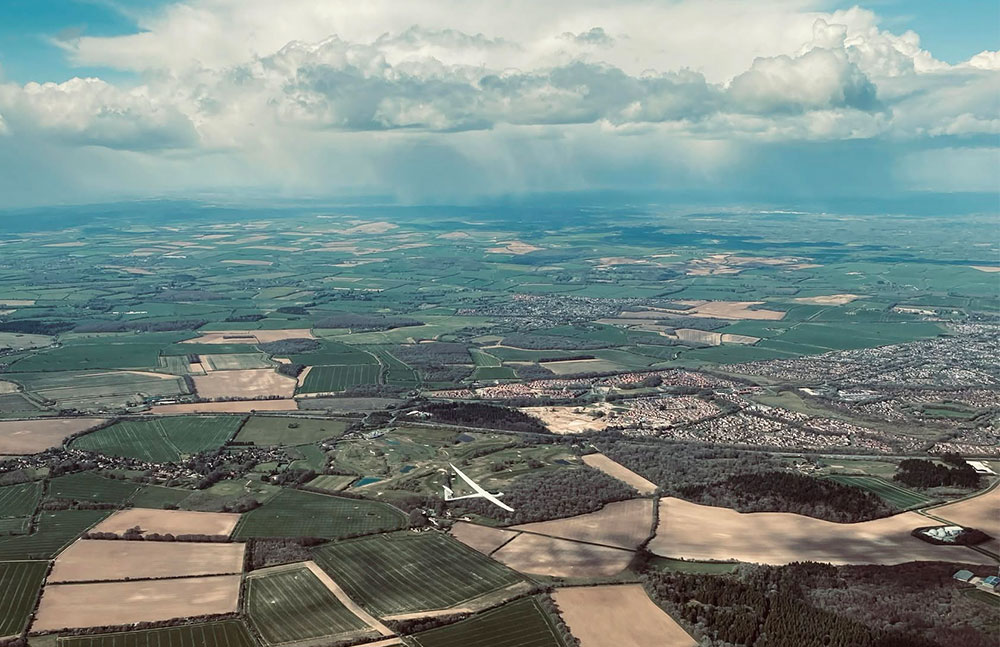
Lasham Airfield, Hampshire 5–13 June 2026
Tom Arscott took the top step at this year's UK Sailplane Grand Prix, held at Lasham over nine days in early June. Flying his Ventus 2a, Arscott accumulated 27 points across three scored tasks to claim the overall title ahead of Oliver Ramsay (LS8, 19 points) in second and Owen Mccormack (Ventus 2a, 11 points) in third. The event drew 20 pilots into the Sailplane Grand Prix class, competing over a run of tasks set in the Hampshire and Wiltshire countryside — when the English summer weather allowed.
Practice Day — 5 June
The competition opened with a practice task on the Thursday, giving pilots the opportunity to familiarise themselves with the local airspace and scoring system before points began to count. The route covered 183.41 km, taking gliders north past Oxford and across to Calvert before returning via Didcot and Candover Church to Lasham. Conditions were evidently difficult — only two pilots completed the full circuit. Howard Jones (Discus 2a) covered 85.88 km before landing out, while Hugh Miller (LS8) completed the task in 3 hours 29 minutes at 52.42 kph. Most of the field landed short of the first turning point, and several pilots did not get away at all. The practice day result carried no points toward the overall competition.
First Points on the Board 8 June
Sunday brought the first real racing of the competition. A 113.86 km circuit was set from Lasham, heading south-west to Salisbury Cathedral, then north to Mottisfont Station, east to Bullington, and finishing back via Candover Church. The window opened at 17:00, and starts were tightly grouped within a minute.
Tilo Holighaus (Ventus 3T) led the field home in 1 hour 24 minutes 50 seconds at a speed of 80.10 kph, earning the ten points available to the day's winner. Tom Arscott was second in 1 hour 34 minutes 43 seconds at 71.80 kph, taking eight points. Five pilots finished the full circuit in the competition window: Toby Freeland (ASG 29 15m) was third home at 69.74 kph, earning five points, while Stanisław Biela (Ventus 3TS), Owen Mccormack, Kim Tipple (ASG 29 15m), Neil Mclaughlin (Ventus 2a), and Wojciech Domański (Ventus 2a) all completed the course but received no points under the scoring structure.
The remainder of the field landed short. Oliver Ramsay, Henry Inigo-Jones, Howard Jones, Jez Hood, Björn Gintzel, Oscar Butlin, Paul Fritche, and Ayala Truelove all covered approximately 51–52 km before landing, suggesting the conditions deteriorated markedly somewhere out on the task. Ian MacArthur and Hugh Miller reached similar distances, while Nigel Mallender started very late and barely left the airfield circuit. Jan Knischewski did not fly.
After Task 2, Holighaus led the overall standings with 10 points; Arscott sat second with 8.
9 June: A Difficult Day Scored on Distance
Monday produced another marginal day. The task set was 116.38 km from Lasham to Newbury North, west to Marlborough, and back via Candover Church — the same route that would later be used for Task 4. No pilot completed the circuit, and all were recorded as Did Not Fly in the conventional sense, yet the day was scored using GPS logger data from the flight attempts, with positions determined by how far each pilot progressed toward the goal.
Oliver Ramsay was credited with first place and earned ten points, with Tom Arscott second on eight points. Ian MacArthur was third for seven, Kim Tipple fourth for six, Oscar Butlin fifth for five, and Owen Mccormack sixth for four points. Neil Mclaughlin took three points in seventh, Ayala Truelove earned two in eighth, and Stanisław Biela claimed one point in ninth. The remaining pilots received no score.
The result reshuffled the leaderboard considerably. Arscott, who had been runner-up on Task 2 and took eight more points here, moved ahead of Holighaus — who scored nothing on Task 3 — into the overall lead.
Task Cancelled
Wednesday repeated the same route as Task 3 — 116.38 km to Newbury North and Marlborough — and a group of pilots launched at 17:16, flying varying distances into the task. However, conditions did not allow completion and the day was cancelled with no points awarded. Ian MacArthur flew furthest, reaching 51.50 km, while several others made distances between 26 and 46 km before returning or landing out. Kim Tipple did not start. The cancelled day left the overall standings unchanged.
Task 5 — 13 June: The Final Day Decides It
The competition closed on Friday with its longest task of the week: 153.47 km. The circuit ran from Lasham to Newbury South, west to Andover SW, back to Lasham, out again to Newbury South, then to Andover SE, Candover Church, and finally home — a demanding double-leg route across the Hampshire countryside.
As on Task 3, no pilot completed the circuit, and results were again determined by a distance-based scoring of GPS data. Arscott was awarded first place and eleven points — the highest single-task score of the competition — with Ayala Truelove taking second and eight points, and Owen Mccormack third with seven. Björn Gintzel earned six for fourth, Stanisław Biela five for fifth, Jez Hood four for sixth, Howard Jones three for seventh, and Oliver Ramsay two for eighth. Paul Fritche picked up one point in ninth.
The eleven points from the final task proved decisive for Arscott, who ended the competition on 27 points overall. Ramsay's eight points from Task 3 and two from Task 5 gave him 19 in total for second place, while Mccormack's consistency across Tasks 3 and 5 saw him finish third on 11 points.
Full results and task details are available at soaringspot.com and the official results portal at crosscountry.aero.