

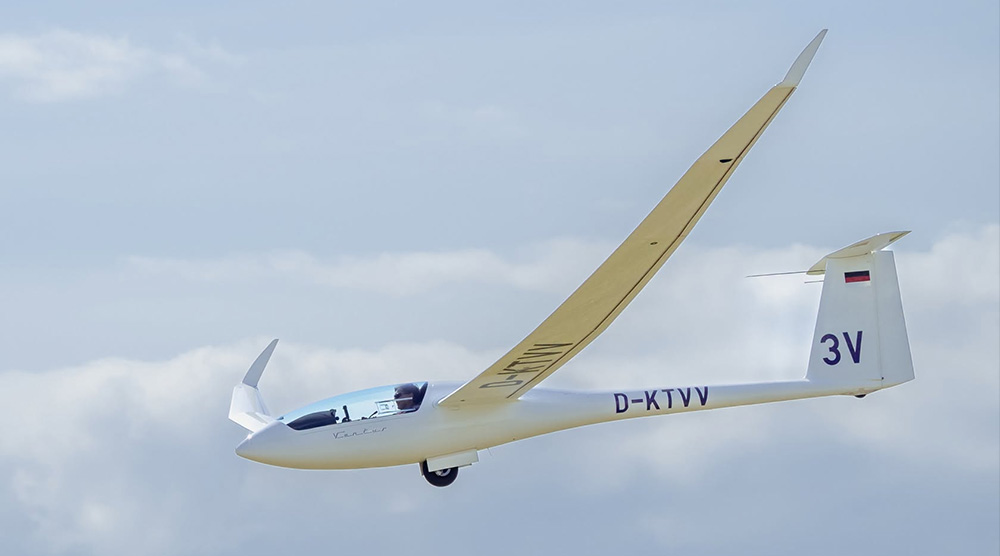
The third round of Series 13 of the FAI Sailplane Grand Prix took place at Elverum Starmoen in Norway from 28 June to 4 July 2026, operating out of the Ole Reistad Senter. Thirteen gliders lined up for the event, contested over Norway's characteristic mix of northern hills and mountains and softer flatland to the south.
The grid included Klaus Kalmbach and Michael Pfennig of Germany, Petr Panek of the Czech Republic, and a strong Norwegian contingent led by local pilot Arne Martin Güettler, alongside Jo Inge Bjørø, Kato Kvitne, Eirik Brenner Marthins, Rune Hovda and Steinar Oksenholt. The international entry also included Schempp-Hirth CEO Tilo Holighaus of Germany, Mikael Widén of Sweden, Teet Jagomägi of Estonia, Luka Žnidaršič of Slovenia, and Maciej Walasek of Poland. Starmoen had previously hosted the Grand Prix in 2024, when Germany's Conrad Hartter took the title ahead of Kalmbach and Güettler, and several of that year's competitors returned this time looking to improve on their result.
Holighaus opens with the fastest average speed of the week
Racing began on 28 June following two practice days. The task sent the fleet north for 261 km through Atna, Åkrestrømmen, Hovdedalen and N Løset before a run home via Hernes church, taking in views of the Rondane and Sølen ranges. A westerly wind and a cloud base forecast above 2,500 metres gave the fleet a fast day, with the leaders averaging close to 130 kph.
Tilo Holighaus took the win in his Ventus-3T, finishing in 2:02:59 at 127.5 kph. Petr Panek was second in the JS-1b JET, 3 minutes 20 seconds back at 124.1 kph, with Michael Pfennig third in the JS 3 TJ 18m, 7 minutes 7 seconds behind the winner at 120.5 kph. Norway's Kato Kvitne was best of the home pilots in fourth, and Teet Jagomägi rounded out the top five.
Güettler wins Race 2 Through Patience on Leg 4
Day two brought early uncertainty, with light rain leaving a roughly even chance of racing, before a usable window opened in the afternoon behind a passing cold front. Winds were awkward, gusting near 10 knots at low level with a steadier 20-knot flow higher up. The 150 km task ran Starmoen–Åsnes kirke–Holtet–Norhue–Hemsjøen–Hernes kirke–Starmoen, and all thirteen starters finished, though speeds varied widely leg to leg. Scoring speeds across the field clustered between 106 and 113 kph, with thermal averages around 2.0 m/s.
The race turned on Leg 4, the run to Norhue, where the spread between fastest and slowest glider reached 117.3 kph. Rather than press on immediately, Arne Martin Güettler worked with fellow Norwegians Kato Kvitne and Eirik Brenner Marthins to reach a known thermal source near Mt Holshaugen, taking the climb calmly before converting the resulting height advantage into speeds of 157.9 kph and 228.2 kph on the last two legs. He won by 37 seconds from Kvitne, who had the best raw climb performance of the day but lost time on Leg 4. Marthins took third, only 4 seconds behind Kvitne, having flown the most efficient race of the podium with just 12 climbs and 34 per cent of his time spent circling. Jagomägi and Rune Hovda followed in fourth and fifth. At the back of the field, Steinar Oksenholt brought his ASH 26E home in 13th, giving away considerable performance to the 18-metre fleet but completing the task regardless.
Güettler holds off Holighaus by 13 seconds
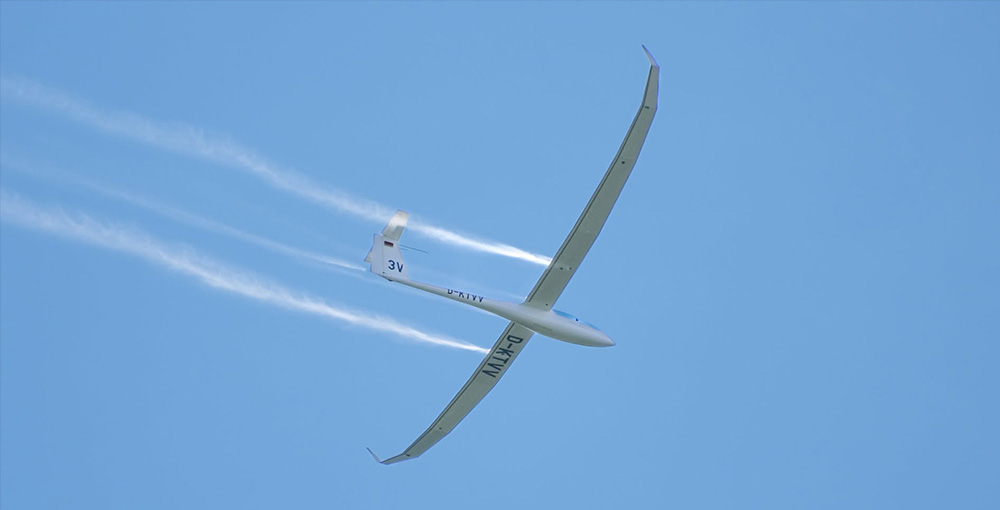
The best weather of the week arrived on 30 June, with forecasts pointing to cloud base above 2,600 metres and possibly beyond 3,200 metres, and light winds throughout. The task was extended to 353 km, taking the fleet deep into the Gudbrandsdalen valley past the Rondane and Jotunheimen national parks. The start gate opened at 12:50 local time, and eleven of the thirteen starters completed the course.
The opening leg to Kvam Kirke was closely matched, with finishers within 4.1 kph of each other, before Legs 2 and 3 opened gaps of 37.1 kph and 32.6 kph. Güettler flew consistently through the middle of the task, then chose a conservative line through the difficult Julussdalen sector on Leg 4, where the field spread by 47.3 kph, before finishing with 187.2 kph and 218.8 kph on the last two legs to take the win by 13 seconds from Holighaus. Holighaus recorded the best individual climb rate of the podium at 4.1 m/s and led Leg 3, but a final glide 14 kph slower than Güettler's cost him the top spot. Petr Panek took third, 1 minute 15 seconds back, having spent only 39 per cent of his flight circling. Klaus Kalmbach was fourth, having reached the highest altitude of the day at 2,424 metres. Teet Jagomägi recovered from a poor Leg 2 to finish seventh, posting the fastest leg of the day at 225.8 kph on the run home. Rune Hovda and Eirik Brenner Marthins both failed to complete the task, with Hovda using his engine to return to the airfield.
Holighaus takes the overall lead
Conditions turned more difficult on 1 July, with a low, broken cloud base and lift rarely exceeding 2.0 m/s. The 151 km task ran south through Gjesåsen kirke, Gjølstad flyplass, Storberget and Jømna, with a minimum finish altitude of 416 metres QNH. Scoring speeds across the field were tightly bunched between 91 and 105 kph.
The result hinged on Leg 3, the push from Gjølstad to Storberget, where Holighaus flew 153.8 kph against a field that was struggling to connect fragmented lift, opening a spread of 69.7 kph between the fastest and slowest gliders on that leg alone. He worked only eight thermals for the entire task and won in 1:26:23 at 104.9 kph. Klaus Kalmbach was second, 43 seconds back, having posted the best individual climb of the day at 2.6 m/s. Kato Kvitne took third after a notable tactical decision on the final legs, flying direct to the finish rather than following the terrain to the east and passing seven pilots in the process. Teet Jagomägi was fourth and Michael Pfennig fifth, only two seconds apart. Petr Panek finished sixth on raw time but was penalised 56 seconds for dipping 14 metres below the minimum altitude band near the finish, and Jo Inge Bjørø recorded the day's only DNF after crossing the line 45 metres below the minimum, outside the permitted tolerance. The result put Holighaus on top of the leaderboard with 30 points, ahead of Güettler on 28 and Kvitne on 23.
Weather stops play
Both 2 and 3 July were cancelled. On the second of these days, organisers tracked the risk of lightning developing over the airfield by mid-afternoon and judged that a fair and safe task could not be run. With flying suspended, the event used the time for a session on the Front Electric Sustainer and the developing E-Glide format, an interview with Holighaus on the aerodynamics of the Ventus 3, a discussion with FES developer Luka Žnidaršič, and a radio broadcast from the cockpit with Norwegian broadcaster NRK. Going into the final day, Holighaus led on 30 points from Güettler on 28, Kvitne on 23 and Kalmbach in fourth, still within reach of the podium.
Kalmbach wins the day, Holighaus takes the title
The final task on 4 July covered 222 km through Holtet, Haslemoen, Pramhussætra, Sigernessjøen, Gjesåsen and Jømna. Thermals again averaged below 2.0 m/s for most of the field, and scoring speeds clustered between 90 and 108 kph, rewarding consistency over raw speed.
Klaus Kalmbach won the race in 2:02:40 at 108.3 kph. The short 18 km Leg 4 to Sigernessjøen produced the widest spread of the day, 121.2 kph between fastest and slowest, and Kalmbach flew it conservatively at 75.1 kph before finishing with 160.4 kph and 197.0 kph on the last two legs. Maciej Walasek was second, 5 minutes 28 seconds back, having matched the fastest Leg 4 speed before losing time on Leg 6. Güettler took third, 33 seconds behind Walasek, recording the fastest leg of the day at 218.0 kph on the final glide. Michael Pfennig was fourth, six seconds further back, with a final leg of 213.8 kph of his own. Rune Hovda and Petr Panek both fell short of completing the course and used their engines to return.
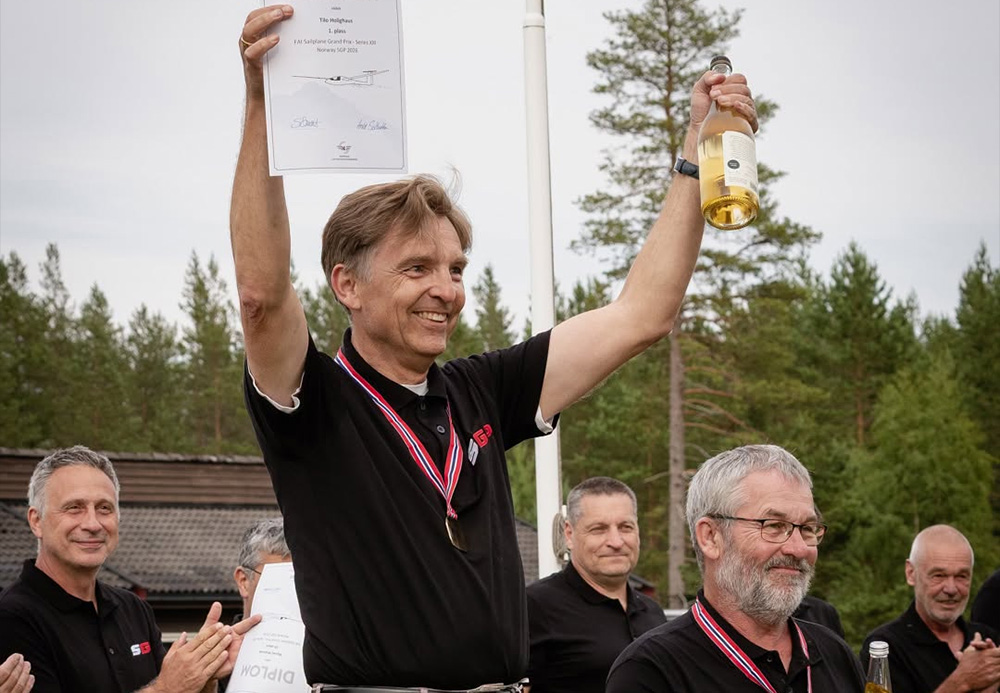
With the daily race decided, attention turned to the overall result. Holighaus and Güettler finished the week tied on 35 championship points, and the title was settled on countback, with Holighaus taking the win and the qualifying place for the World Final in Chile. Kalmbach's final-day victory lifted him to third overall on 33 points. Güettler's second place on countback keeps him on the reserve list for Chile.
Final Standings
- Tilo Holighaus (Germany) – 35 points – Champion, FAI Sailplane Grand Prix of Norway 2026
- Arne Martin Güettler (Norway) – 35 points
- Klaus Kalmbach (Germany) – 33 points
Full recusts at sgp.aero