

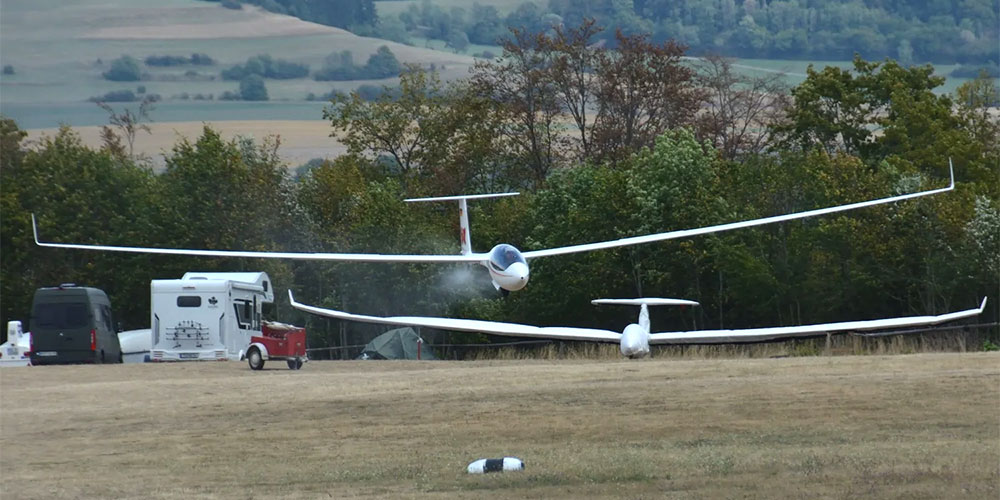
The FAI Sailplane Grand Prix returned to Germany from 9 to 15 August 2026, hosted by FSV Tübingen at Farrenberg, a hilltop airfield between Hahnweide and Klippeneck known among the fleet as the 'aircraft carrier.' Twenty pilots from seven countries lined up, flying a mix of Ventus 3, JS3, JS1, ASG 29, AS 33 and Diana 4 gliders.
Practice Day – 8 August
The training day gave the grid a final look at the terrain before racing began. Conditions were mostly blue thermals, with some high cirrus that burned off during the day. The task committee set a 279 kilometre course from Farrenberg into the Black Forest, with turnpoints at Neustadt-Titisee, Hornisgrinde, St. Georgen and Heufeld before the return to Farrenberg, with a take-off time of 13:00.
Conrad Hartter, flying local knowledge in his JS1c Jet, was first across the start line, but it was Stefan Langer in an AS 33Es 18 metre who took the win by two minutes nine seconds, at an average of 143.8 kph over one hour, fifty-six minutes and ten seconds. The race turned on legs four and five. Langer had been only mid-field through the first three legs, but ran leg four (Hornisgrinde to St. Georgen) at 177.7 kph as the field's speed spread widened to 66 kph, and Hartter answered with 193.1 kph on the same leg, still not enough to close the gap. On leg five, Langer's own pace slowed to 175.9 kph, the slowest of the podium group, but the lead built earlier held. His discipline on the climbs told the story: 36 percent of his flight time spent in just 28 thermals averaging 2.4 metres per second, and a finish height only 31 metres above the minimum, a tight energy budget that worked out.
Peter Millenaar took third in a JS3-Jet 18 metre, just 25 seconds behind Hartter, helped by a 232.3 kph final leg after finding a 4.0 metres per second climb, the best of the day. Michael Reiner was fourth, nine seconds further back, having found the strongest single thermal of the top five at 4.5 metres per second. Dirk Windmüller rounded out the top five, three minutes thirty-two seconds off the lead, flying a consistent race without the late acceleration of the pilots ahead of him.
Race 1 – 9 August
The opening race set a 379 kilometre task and delivered a demanding, shifting day. What started as a fast run under cumulus turned into a tactical battle as heavy rain cells moved into the course on the final leg, forcing pilots to divert around sink and rain and reshuffling the leaderboard.
Stefan Langer, again flying his AS 33 18 metre, took the win in 03:01:54 at an average of 124.7 kph, with finishing speeds across the field clustered between 114 and 125 kph on a day of thermals averaging 2.0 to 2.4 metres per second. Langer's victory was built on two legs in particular. On leg three, from Gerstetten to Ellwangen, he pushed to 149.4 kph while Rasmus Ørskov managed only 123.7 kph on the same stretch. On leg six, the run home from the Heufeld reporting point to Farrenberg, the spread between fastest and slowest pilot reached 133.8 kph; Langer flew it at 238.6 kph, and Ørskov's reply of 223.2 kph left him 44 seconds short at the finish.
Ørskov took second, with Peter Kvistgaard Toft completing the podium in his ASG 29E 18 metre, one minute forty-five seconds behind Langer at an average of 123.5 kph. Toft logged the best climb of the top three at 4.0 metres per second across 46 thermals, though he arrived at the final leg short on height and could only manage 208.0 kph home. Joachim Schwenk finished fifth, four minutes eleven seconds off the lead, having found the sharpest climb of the leading group at 4.5 metres per second in his Ventus 3T. Further back, Björn Gintzel led the mid-field group with the highest average climb rate of any finisher, at 2.4 metres per second.
Race 2 Cancelled
Day two set up a tighter, 273 kilometre, five-leg task weaving through the Swabian terrain and the Black Forest: Farrenberg to Schramberg, north to Nagold, on to Forbach, south again to Neustadt-Titisee, then back via the Heufeld reporting point to finish at Farrenberg. The morning briefing pointed to a workable cloudbase near 2600 metres, but with a clear warning that overdevelopment and afternoon rain could shut the day down.
The gliders launched at 12:15 local time and the grid formed up for a start gate originally planned for 13:30 local, which the race director then delayed further as conditions were assessed. The deterioration arrived faster than forecast. By 14:30 local, with the fleet airborne and jockeying for position, strengthening winds and storm clouds moved into the task area, and the organisers cancelled the race for safety reasons. The entire grid returned to Farrenberg without incident.
With no result to record, the standings from Race 1 carried forward unchanged: Langer at the top with 10 points, Ørskov in second and Toft in third. The grid regrouped to wait for the next flyable window.
Two days into the week, Stefan Langer holds the overall lead after a controlled practice-day win and a tactically sharp victory in Race 1, both decided in the closing legs rather than the opening sprint. Rasmus Ørskov and Peter Kvistgaard Toft sit second and third, each having pushed Langer hard on the final leg home without quite finding the pace to pass him. With racing scheduled to run through 15 August, and the Farrenberg weather already proving changeable, the outcome remains open.
Full results at