

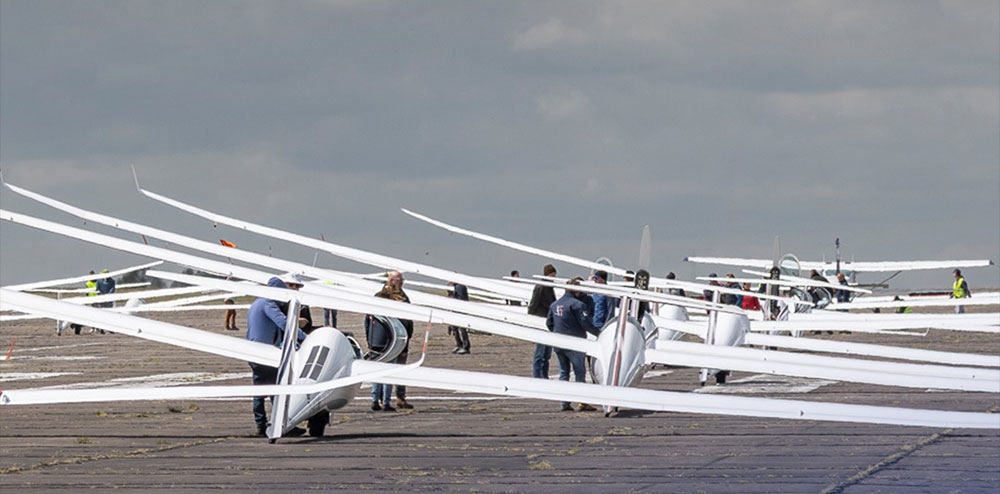
The second and final practice day of the 40th FAI World Gliding Championships at Częstochowa-Rudniki gave pilots across all three classes the chance to make final preparations before competition begins on 16 May. With shorter tasks than Practice Day 1 and conditions that appear to have caught out more than a few crews, the day produced a mixed picture — some clean finishes at solid speeds, a long tail of pilots who landed short of goal, and a notable number who never got airborne at all.
Open Class
The Open Class task was an Assigned Area Task with a two-hour window, set over turnpoints taking gliders north and east of the airfield before returning home. The nominal task distance sat at around 178 km, though the fastest pilot managed to stretch that considerably.
Felipe Levin (EB 29R, contest number FL) was the only pilot in the class to complete the task and cross the finish line, covering 201 km at 90.48 kph over 2 hours and 13 minutes to take the day win with 273 points. It was a well-judged flight that made the most of whatever the day was offering.
Behind him, Max Leenders (EB 29DR) and Oscar Goudriaan (JS5) both landed out having covered 177 km, sharing second place on 223 points each. Michael Sommer (EB 29R) reached 168 km for fourth, while defending title contender Sebastian Kawa (JS5) fell back to fifth having managed only 150 km. Pierre de Broqueville (EB 29DR) covered 79 km before going down, and Sylvain Gerbaud and Jan Buch-Madsen both scored zero — Gerbaud for starting outside the PEV interval, and Buch-Madsen for failing to use PEV at all, which also earned a formal warning under SC3A 7.3.2.c.i.
Five further pilots recorded DNFs without covering any meaningful distance, and Christian Hynek did not start.
It is worth noting that Open Class is the smallest fleet at this championship, with around 16 pilots, so the task conditions clearly caught many of them in a difficult situation. Only one finisher from that group is an unforgiving result that will serve as a useful warning ahead of the first scored day.
18 Metre Class
The 18 Metre class had the largest and most complete field on the day, with 33 pilots getting away and producing a full range of results. The task was an Assigned Area Task of around 229 km nominal distance, again with a two-hour duration.
Thies Bruins (JS3 TJ 18m, CN: IV) took the class win, covering 232.64 km at 108.75 kph to score 514 points. It was the fastest speed of any single-seater class on the day. Mario Kiessling (Ventus 3T 18m) finished second at 105.77 kph with 500 points, completing the task in just under two hours. Stanislaw Biela (AS 33 Es 18m) rounded out the podium in third at 100.41 kph with 475 points, covering the longest distance of the three at 238.50 km — a sign that he pushed deep into the assigned areas.
Fourth through seventh place was closely contested, with Boris Žorž, Karol Staryszak, Bernhard Leitner, and Werner Amann all finishing within a few kilometres per hour of each other, ranging from 99.32 kph down to 94.85 kph.
Further down the field, Derren P. Francis, Linas Miežlaiškis, and Matthew Davis shared eighth place at effectively the same speed — all around 90.90 kph — reflecting how finely matched many of these 18m gliders and pilots are.
The day was not without incident. Rune Hovda received a penalty for self-launching above 912 metres, Christophe Abadie collected a warning under SC3A 7.10.1, and Adomas Grabowski was penalised for not activating PEV. Eight pilots recorded DNFs including Petr Krejcirik, Ronny Eriksson, Sjaak Selen, Alena Netusilova, and Joze Verdev, while Victor Mallick did not start.
20 Metre Multi-Seat Class
The two-seat class flew an Assigned Area Task of around 194 km nominal over two hours, routing northeast and south of the airfield before returning. Handicapping was enabled for this class.
Jones & Coppin (Arcus M, CN: i10) took first place, completing the task in 2 hours 4 minutes at 95.72 kph to score 506 points — a clean flight that set the standard for the day. Leucker & Omsels (Arcus T) came second with 466 points at 88.68 kph, followed closely by Delfosse & De Broqueville (Arcus T) in third at 88.41 kph with 465 points. The margins between second and third were tight enough that a slightly different routing might have reversed them.
Ghiorzo & Gostner (Arcus M) finished fourth with 433 points, covering the greatest distance in the class at 210.41 km, while Girado & Bossart (HpH 304 TS Twin Shark) rounded out the top five — notable as the only non-Arcus glider in the top half of the field.
Woolley & Gateley (Arcus M, CN: VH) were the ninth-placed crew and the highest-finishing team that did not make it back to the airfield, covering 180 km. The French pairing of de Péchy & Duboc, who won Practice Day 1, had a difficult day by comparison, placing eleventh with just 105 km covered and 162 points. Three crews recorded DNFs.
Looking Ahead
The competition proper opens on Saturday 16 May, with pilots and teams now focused on whatever final adjustments their results and the conditions have suggested. The 18 Metre class looks deep and competitive across the board. Open Class will be watching the weather closely after a day where only one glider reached the finish. And in the two-seat class, the Arcus M and Arcus T dominate the fleet — but as Jones & Coppin showed today, glider type is only part of the story.
The opening ceremony is on Saturday 16 May