

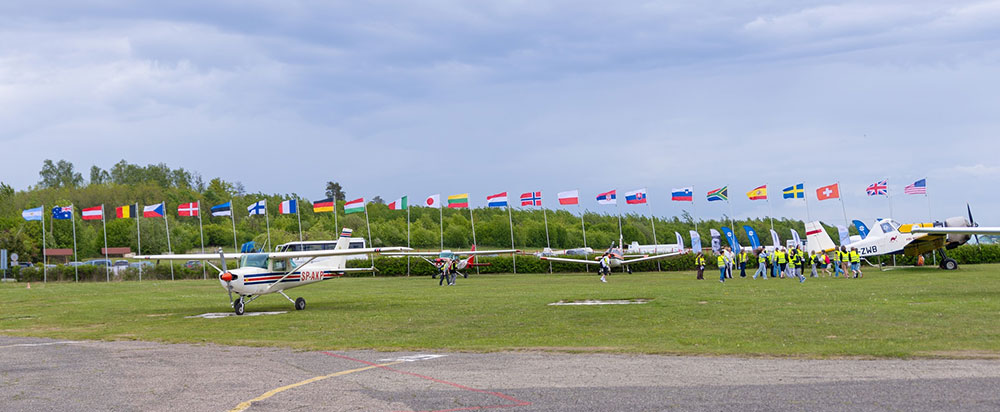
Practice Day Sets the Scene at Częstochowa
The 40th FAI World Gliding Championships opened its practice flying on 13 May 2026 at Częstochowa-Rudniki in southern Poland, giving competitors their first real look at the local conditions ahead of the official contest period running from 16 to 30 May. Three classes took to the air — Open, 18 Metre, and 20 Metre Multi-Seat — each flying an Assigned Area Task with a nominal duration of two and a half hours.
The entry lists reflect the breadth of the world gliding community. The 18 Metre class fields the largest group, with around 40 gliders registered. Open class is a smaller but characteristically high-performance field of 18 gliders, while the 20 Metre Multi-Seat class brings 17 two-seat crews.
Open Class
The Open class task covered a nominal distance of 204.71 km, with a maximum possible distance of 393.30 km. Only three of the 18 starters managed to complete the course, which in itself says something about the difficulty of the day.
Max Leenders (Netherlands), flying an EB 29DR with the contest number UFO, took first place with a speed of 90.09 kph over 230 km. Sebastian Kawa (Poland), flying a JS5, was second at 102.10 kph — the fastest speed of any finisher in the class, achieved over the full nominal distance of 309.36 km having elected a later start. Bas Seijffert (Netherlands) in an EB 29R rounded out the top three at 91.54 kph.
The scoring system penalised several pilots for starting outside the PEV (Post-Exit-Velocity) interval, a procedural requirement that caught out both Kawa and Seijffert despite their strong performances. Christian Hynek covered 132.70 km before landing out, while a number of pilots either did not start or recorded no valid distance. One pilot, Russell Cheetham, also fell foul of the PEV start rules alongside an incorrect landing procedure notation.
18 Metre Class
The 18 Metre task was set over a nominal distance of 202.33 km with a maximum of 337.51 km. Conditions produced a more distributed result, with ten gliders completing the course and a further group landing out at various points along the way.
Swiss pilot Yves Müller won the day flying an ASG 29 18m at 88.50 kph, covering 228.71 km. American Norm Bloch, in a JS3 TJ 18m, came second at 82.96 kph, with Poland's Karol Staryszak third at 79.72 kph in an AS 33 Es. Australia's Matthew Davis (JS3 TJ 18m) and Britain's Derren Francis (Ventus 3T 18m) tied in fourth place at 78.87 and 78.79 kph respectively over very similar distances.
Danish pilot Arne Boye-Møller flew the longest distance of the day in the class — 290.41 km — in just under four hours, finishing sixth. Stefan Langer flew 286.50 km but received no PEV credit, which materially reduced his points despite a fast speed of 88.32 kph. Sarah Arnold did not complete the course but covered a solid 184.55 km. The class produced a long tail of landouts, with a significant number of competitors accumulating fewer than 100 km on a day that was evidently patchy. An airspace violation for Boris Žorž and a missing IGC file for Rune Hovda (who was penalised 50 points) added to the complications of the day.
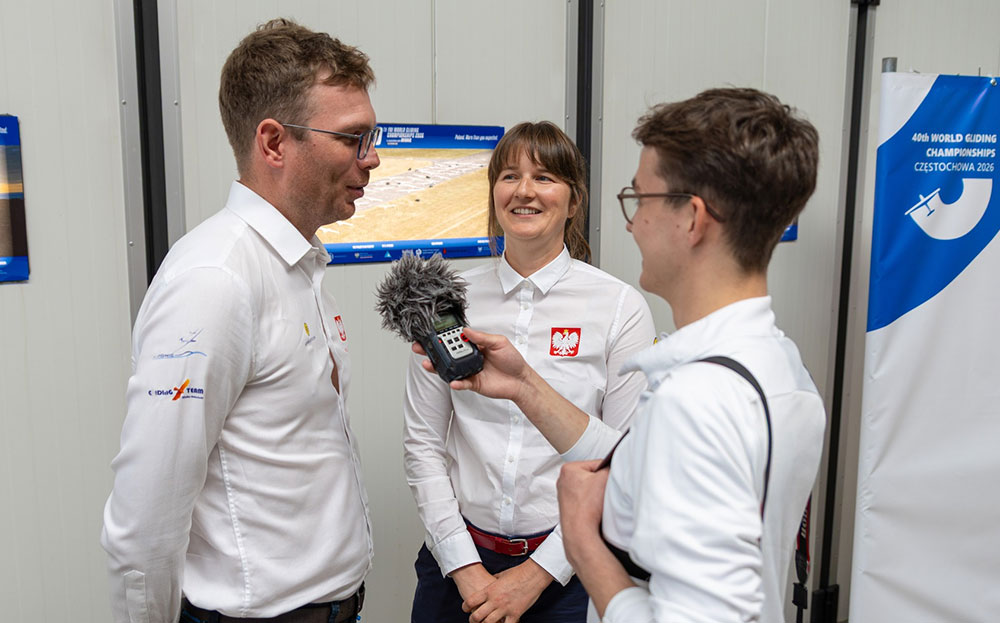
Łukasz Grabowski is flying for Poland in 20m Multiseat Class with Judyta Czyż in am Arcus M.
20 Metre Multi-Seat
The multi-seat task was the shortest of the three, with a nominal distance of 180.27 km and a maximum of 363.15 km. Handicapping was enabled for this class, which affects the points calculation.
The French pairing of de Péchy and Duboc took the top result in an Arcus T, covering 206.23 km at 80.48 kph for 566 points. German crew Leucker and Omsels were close behind at 78.29 kph over 253.20 km for 560 points. The Austrian pair Janowitsch and Lutz landed out at 203.49 km but still scored 400 points under the distance-scoring provisions. Only two crews finished the course in this class.
Several teams did not fly at all, and one crew — Ghiorzo and Gostner — received zero points after being penalised for engine use without returning home. Finnish crew Kettunen and Sorri were docked 50 points for failing to deliver an IGC logger file.
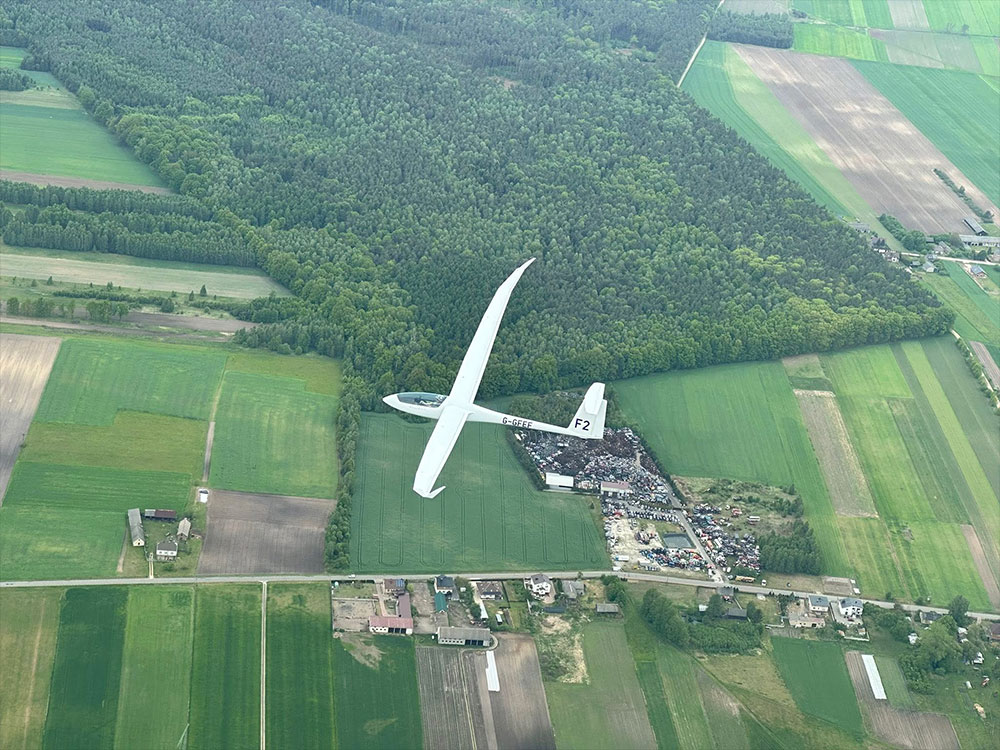
Derren Francis flying for Great Britain in 18m Class ina Ventus 3
General Observations
The practice day gave a useful indication of the procedural complexity awaiting all classes. PEV compliance clearly caught a number of pilots off guard, with incorrect start interval selections affecting results across all three classes. This is particularly relevant for the 18 Metre class, where the large field means briefings and start sequencing will demand careful attention.
The official competition begins on 16 May. With the Polish summer still settling in and a mixed bag of practice day performances across all classes, the two weeks ahead are likely to reward pilots who manage their tactics carefully and stay on the right side of the scoring rules.
Full results and task details are available at soaringspot.com/en_gb/wgc2026