

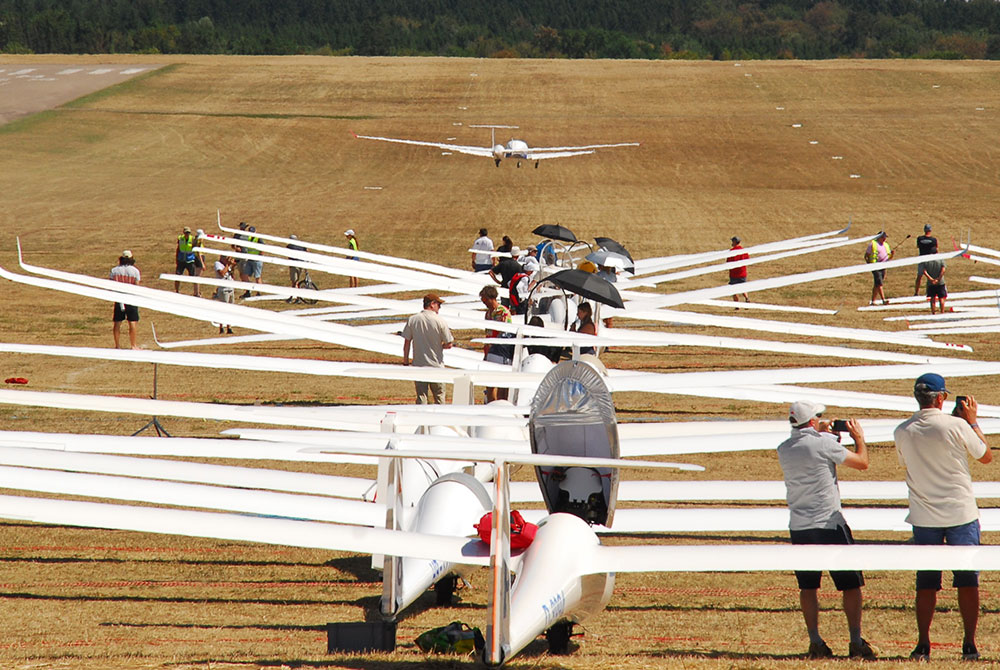
The 14th FAI Junior World Gliding Championships, running at Aalen-Heidenheim/Elchingen in Germany from 1 to 14 August, delivered its tenth task on 13 August, and it proved to be one of the more demanding days of the fortnight for both the Standard and Club class fleets.
Standard Class
Standard class pilots were sent on a 248.75 km racing task, tracking through Denkendorf, Greding, Rothenstein and the BAB-Kreuz A6A7 motorway junction before returning to Aalen. Thirty one pilots took the start, and the day rewarded those who committed early and kept the average speed high through what were clearly workable but not straightforward conditions.
Max Maslak of Germany, flying an LS 8 neo, took the day at 111.74 kph, holding off Patrick Benoist, also flying for Germany in an LS 8 neo, who finished second at 109.11 kph. Antoni Zawirski of Poland rounded out the top three in his LS 8 at 106.96 kph, with Switzerland's Bryan Uhlmann close behind at 106.68 kph. The spread through the top ten was tight, with barely eight kph separating first from tenth, a sign that the task was well set for the day's weather.
Not every pilot got home. Rostyslav Redchuk of Finland and Patrick Cernuto of the United States both landed out short of the finish, while Jens Kammerer of Germany did not fly.
With this result added to the overall standings, Max Maslak now leads the Standard class after ten tasks, followed by Jacob Bøgelund Lassen of Denmark and Lasse Edslev, also of Denmark, in third. The top of the table remains congested, and there is still time for the placings to shuffle before the championship concludes.
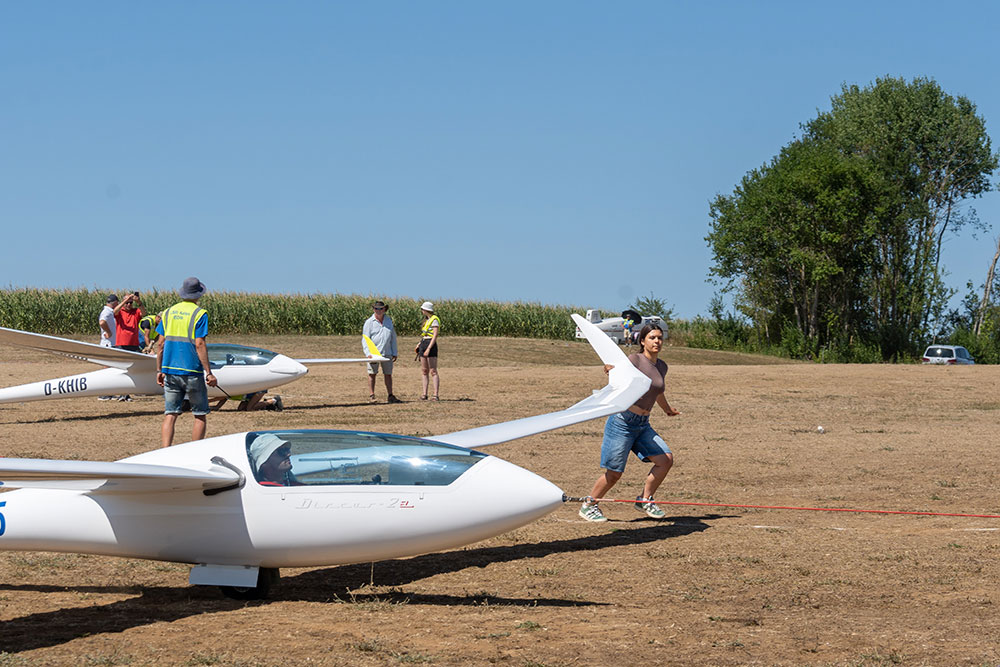
Club Class
The Club class task covered 263.04 km, taking pilots out via Plettenberg, the Dreifaltigkeitskapelle and Sigmaringen before the run home to Aalen. With handicapping applied across a varied fleet that ranged from LS 4s and LS 7s to ASW 20s and a Standard Libelle, the day produced a close and competitive result once corrected speeds were compared.
Florian Kraja of Germany, in an LS 7, took the win with a handicapped speed of 96.95 kph. Tomasz Kurowski of Poland was second at 99.56 kph in an LS 3, with his compatriot Julia Walowska third at 99.20 kph, also in an LS 3. Michiel Haemels of Belgium, flying an LS 4, completed the leading group in fourth.
The Club class day was harder on the fleet than Standard, with eleven pilots recording a did not fly result and several more, including Sofus Skarby-Reif of Denmark, Gabriel Gradin of Sweden and Petr Mašík of the Czech Republic, landing short of the finish. It underlines how much closer to the margins the handicapped fleet often operates compared with the more homogeneous Standard class grid.
In the overall Club class standings after ten tasks, Max Scutchings of Australia leads in his ASW 20, with Nicolas Caudrelier of France second and Nils Zitzelsberger of Germany third. As in Standard class, the gaps near the top are small, and the final tasks of the championship are likely to decide the medals.
Final Race
There is at most one further task available in each class before the results are finalised. Both fleets will be hoping for another flyable day to settle the standings, with the top three in each class currently separated by margins that a single good or bad task could easily overturn.
Full results, task sheets and daily coverage are available on Soaring Spot at soaringspot.com/en_gb/jwgc2026.