

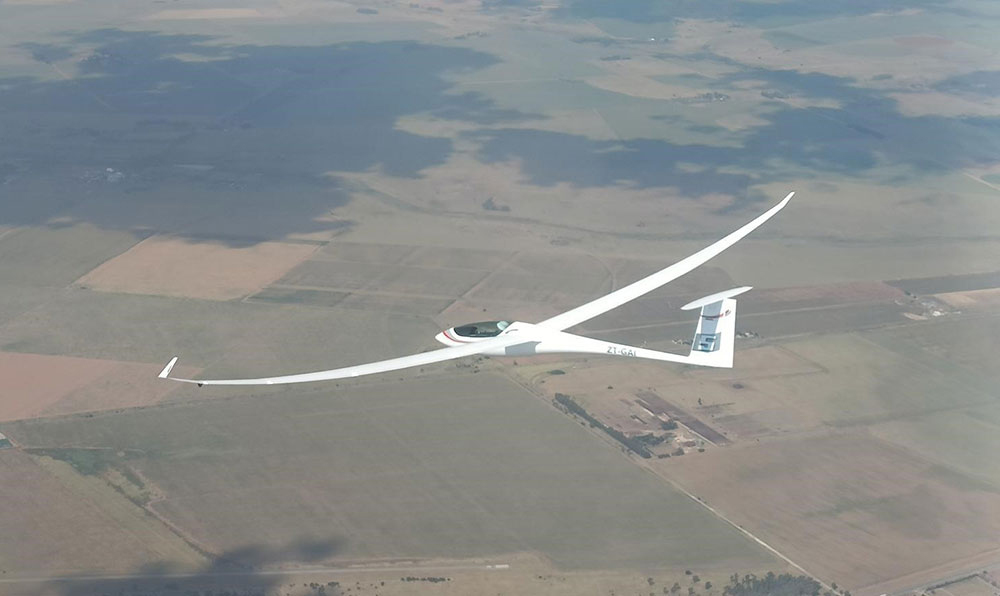
Jonker Sailplanes has been producing competitive composite gliders from Potchefstroom, South Africa, since 2004. For most of that time the company's open class presence rested on the JS1C, a 21-metre sailplane.
The JS5 Rey — named in the tradition of Jonker's Spanish-themed model titles — is the answer to that gap, and it represents the company's first purpose-built open class design rather than an adaptation of an existing airframe.
The wingspan question turned out to be the first significant design decision. Jonker's engineers ran repeated iterations across a range of spans and concluded that 24.2 metres represented an optimum, with structural stiffness and handling becoming progressively harder to manage beyond that point. The result is a glider that sits at the shorter end of the open class field, a deliberate trade-off that shows in both the polar and the cockpit.
Why 24 metres?
Long wings carry inherent penalties in stiffness and torsional rigidity. At 28 or 29 metres the structural demands push weight upward and begin to degrade the very performance the extra span was intended to deliver. Jonker's analysis pointed to 24 metres as the point where the curve flattens and then reverses. The JS5 shares its fuselage with the JS2, and the inner wing section was redesigned specifically for this aircraft rather than carried across from a shorter-span model.
"Our main goal with the JS5 was to climb really well in small broken thermals — and that has significantly improved compared to the JS1C." Uys Jonker, Jonker Sailplanes
The lightweight structure is central to the thermal-climbing argument. A glider that weighs less at the same span can exploit smaller, weaker lift sources and stay aloft into the last thermals of the afternoon. Jonker has been direct about this goal from the outset, positioning the JS5 as capable across the full energy spectrum of a soaring day rather than as a machine optimised purely for fast cruise in strong conditions.
In the air
Pilots who flew the prototype before its world championship debut noted clean handling and a balanced feel across the speed range. One experienced open class pilot, flying a comparison with the JS3 over varied cumulus conditions, covered 750 kilometres at a task speed of 152 kph. The roll response at competition cruise speeds was described as crisp without being twitchy, and the ability to hold a yaw string through 45-degree bank transitions was noted as better than most longer-span contemporaries.
The cockpit has been revised from the JS1 layout rather than the JS3. The canopy rail sits at arm height rather than shoulder height, which Jonker describes as a practical improvement for entry and exit. The instrument panel has been moved closer to the pilot by a modest amount and the sunhood extended, details that become relevant on long days in strong sunlight. The cockpit dimensions are described as the largest in their performance class, and the basic arrangement will be familiar to JS3 pilots without being identical to it.
The Uvalde debut – WGC Poland 2026
The JS5 made its world championship debut at Uvalde, Texas, in August 2024, competing for the first time with a maximum take-off weight of 770 kilograms. Post-competition analysis determined that this was insufficient for the wing loading needed to fully exploit the polar at high cruise speeds. For genuinely competitive open class performance — where cruise speeds in strong conditions in Texas regularly approach 160 kph — a wing loading of around 60 kg/m² is required. The MTOW has subsequently been raised to 800 kilograms to address this, a change Jonker expects to have a meaningful effect on high-speed performance.
The debut itself took place under compressed circumstances. The SOLO engine originally planned for the aircraft was delayed, and the prototype flew at Uvalde with a jet sustainer installation that was not configured for optimal competition performance. Despite this, pilots and observers remarked on the glider's low-speed behaviour, its controllability, and the overall balance of the design. The limitations were structural and regulatory rather than aerodynamic, and the feedback from the competition was substantively positive on the flying qualities.
Seven JS5s are entere to flay at WGC Poland in May 2026 for the types first major outing. It will be interesting to see how it performes against the EB29 aand the other Jonkker models, JS3 and JS1.
Propulsion options
The standard self-launching option is the SOLO 2625-02i NEO Silent, a liquid-cooled, fuel-injected twin-cylinder engine producing 50 kW. The engine emerged from a three-year joint development programme between Jonker and SOLO, motivated by vibration levels in the original installation that could not be adequately managed through mounting changes alone. The companies instead addressed the problem within the engine's balancing shaft system, a process that consumed the better part of two years. Endurance testing is complete and production engines are in build. The alternative sustainer is the MD-TJ42 jet turbine from M&D Flugzeugbau, a single-spool unit with FADEC operation that installs in the JS5 with no reported change in glide ratio with the engine retracted. Both systems deploy and retract cleanly and the operational demands on the pilot are low in either case.
Water ballast capacity in the main wings stands at 190 litres, and the system includes automated controls, a dump sensor, and limit switches for gear and airbrakes. Bug wipers are fitted as standard using the CuttingEdge winder system, and the boundary layer management uses a combination of blow-holes and zig-zag tape depending on configuration. Control surface gaps are sealed with a Teflon and Mylar system. The safety fit includes a fire warning system as standard, hydraulic disc braking via a dedicated stick lever, and FLARM and transponder antennas integrated into the fin.
Certification and outlook
Jonker is producing around 42 aircraft in 2026 across its full range, a figure that reflects a deliberate reduction in output while final assembly congestion — caused in part by engine delays — is cleared. A new 10,000-square-metre facility is being commissioned to support future production volumes. The JS5 is in build alongside the JS2, JS3 RES, and the forthcoming JS4, and Jonker has stated that the JS5 development phase is now substantially complete, with engineering resource shifting to the standard class JS4 Rengeti.
The MTOW was raised from 770 kg to 800 kg after the Uvalde experience showed that a wing loading of around 60 kg/m² is needed for high-speed cruise dominance in the open class.
The NEO Silent engine, which was the result of a three-year co-development between Jonker and SOLO, has completed endurance testing and certification documentation has been submitted, with the production line currently building four engines per week.
JS5
Wingspan 24.2 m
Glide ratio 68 :1
MTOW 800 kg
Max speed 193 kph